
Tutorial Categories
Last Updated: January 27, 2026 at 10:30
Liquidity and the Birth of the Stock Market - World Financial History Series
Liquidity did not emerge from a desire for faster trading or better prices. It emerged from a fundamental collision: the birth of the permanent enterprise and the human unwillingness to remain permanently exposed to distant, uncertain outcomes. By making ownership transferable, Amsterdam transformed risk from something you endured over time into something you could transfer through exit. This did not remove danger—it redistributed it across participants and moments. In doing so, liquidity quietly changed what ownership meant, what responsibility felt like, and what money itself represented.
Setting the Scene: A World of Long Commitments and Uncertain Returns
To understand why the world’s first stock market mattered, we need to begin with a world where liquidity did not exist in any modern sense.
For most of human history, participating in long-distance trade, large infrastructure projects, or state finance required one thing above all else: long-term commitment. If you invested money in a caravan, a ship, or an expedition, that money was effectively gone for years. You could not easily reverse the decision. You could not sell your claim to someone else. You waited—often with little reliable information—hoping that goods would return safely, that prices would still be favorable, and that wars, weather, or politics would not undo everything in the meantime.
This environment shaped behavior in very specific ways.
Only people with significant surplus wealth, social protection, or political backing could participate repeatedly. Losses were accepted as part of the activity, but they were also deeply personal. A failed voyage could mean long-term financial damage, not a temporary inconvenience. Risk could be shared among participants, but time was inflexible. You entered together, and you waited together.
Markets in this world were episodic rather than continuous. They appeared at fairs, ports, or seasonal gatherings. Prices mattered at the moment of exchange, but exit did not exist as a meaningful concept. Once you committed capital, your fate was tied to the outcome.
That constraint shaped the meaning of ownership itself.
Ownership implied responsibility over time. It meant exposure to outcomes you could not escape. It encouraged caution, patience, and close monitoring of partners—not because people were unusually disciplined or virtuous, but because reversal was costly. Behavior followed structure.
The Problem the Dutch Were Trying to Solve
By the late sixteenth century, the Dutch Republic faced a problem that was both economic and political.
It was a small, recently independent state competing against large empires with vast resources. Dutch merchants were active across Asia, Africa, and the Americas, but long-distance trade was slow, expensive, and dangerous. Ships took years to return. Many never returned at all.
Early Dutch trading ventures followed the prevailing model of the time: temporary partnerships formed around a single voyage. Capital was raised, ships were sent, profits or losses were divided, and the partnership dissolved.
This structure distributed risk across investors, but it created persistent coordination problems.
Each voyage required fresh fundraising. Each partnership had to renegotiate terms. Investors could not plan far ahead. Managers had incentives to maximize the success of this voyage rather than invest in durable infrastructure or long-term relationships. Multiple Dutch expeditions competed against one another for the same goods, driving up costs and weakening their position against better-coordinated rivals.
The problem was not irrationality or incompetence. It was fragmentation under uncertainty.
What the Dutch needed was a way to pool capital on a permanent basis while still attracting participants who were understandably reluctant to lock up their wealth indefinitely.
The VOC: Permanent Capital Meets Human Reluctance
The solution, when it arrived, was institutionally radical.
In 1602, the Dutch state chartered the Vereenigde Oostindische Compagnie—the Dutch East India Company, or VOC. Instead of forming a partnership for each voyage, the VOC would exist indefinitely. Investors would contribute capital once, and that capital would remain inside the enterprise.
This permanence solved several problems at once.
It allowed the company to plan across decades rather than voyages. It reduced destructive internal competition. It enabled large-scale investment in ships, forts, warehouses, and logistics. It aligned the company’s survival with the geopolitical interests of the Dutch state.
But it immediately created a new and serious problem.
Investors had no clear path to reclaim their money.
There was no scheduled dissolution. No guaranteed liquidation. Dividends were uncertain, irregular, and dependent on distant outcomes. For many potential participants, this level of commitment felt dangerous rather than attractive.
The VOC did not deliberately design a solution to this problem. Instead, the solution emerged from the environment around it.
The Accidental Birth of Liquidity
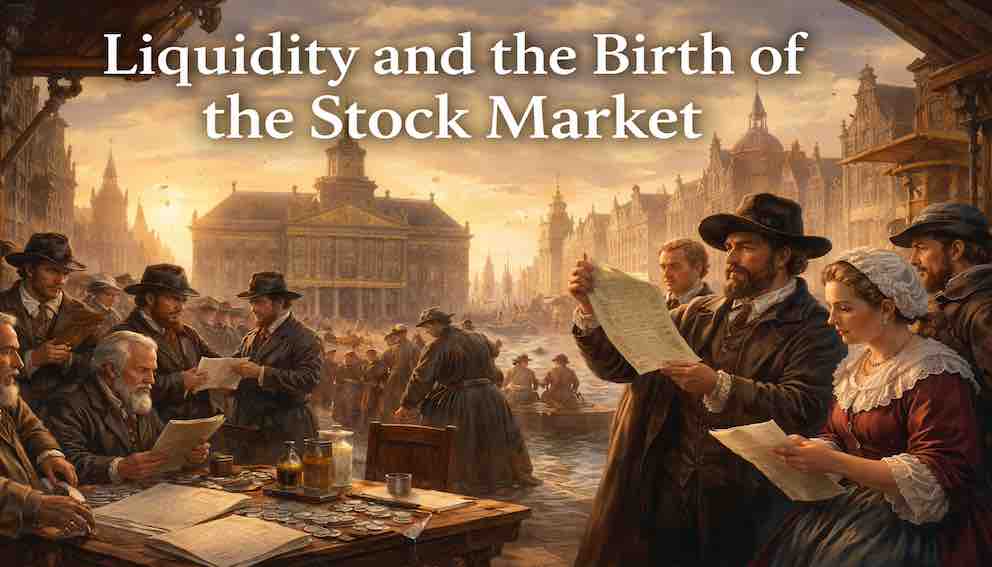
VOC shares represented claims on future profits. Nothing in the company’s charter prohibited selling those claims to someone else. And in Amsterdam—a dense commercial city with merchants, legal specialists, and fast-moving information—people began to trade them.
At first, this trading was informal and pragmatic.
An investor who needed cash could sell a share to someone else willing to hold it. Prices varied based on rumors, ship arrivals, wars, storms, and political developments. Over time, certain locations, customs, and intermediaries emerged to make these exchanges more regular.
Crucially, a pool of willing buyers already existed.
Amsterdam in the early seventeenth century was awash in capital. Wealth flowed not only from trade, but from refugees—particularly Protestants fleeing the Spanish Netherlands—who arrived with savings and needed places to store and grow them. Estates and widows sought income-producing assets that did not require direct management. Others wanted exposure to global trade without boarding a ship bound for Asia.
This latent demand mattered.
Liquidity requires not just someone who wants to sell, but someone consistently willing to buy. The secondary market became viable because different participants found VOC shares useful for different reasons and different time horizons.
As trading increased, so did the supporting infrastructure.
VOC shares were registered and legally transferable, a crucial innovation that made ownership clear and enforceable. The Wisselbank, founded in 1609, provided reliable settlement and reduced counterparty risk by ensuring that payments actually occurred. Notaries and brokers standardized contracts and recorded transactions.
Liquidity was not merely an idea. It was an ecosystem.
This ecosystem lowered the friction of exchange enough to make trading routine rather than exceptional.
For the first time, ownership no longer required waiting for the underlying activity to conclude.
You could exit early.
This was liquidity: the ability to convert a long-term, uncertain claim into immediate purchasing power.
It did not eliminate risk. Prices moved. Buyers misjudged. Sellers exited too soon. But liquidity changed who bore risk and for how long.
Time itself became tradable.
How Liquidity Changed Behavior
Once investors understood that shares could be sold, their relationship to risk shifted.
They no longer needed to evaluate the VOC solely as a decades-long enterprise. They could focus on nearer-term expectations: the next fleet’s arrival, the next dividend announcement, the next political development.
Time horizons shortened.
Ownership itself changed character. Holding a share no longer meant overseeing a venture. It meant occupying a position—often temporarily.
This encouraged broader participation and increased capital flows. But it also weakened the psychological bond between owner and enterprise.
Most importantly, liquidity made selling an alternative to engagement.
If you disagreed with management, you could exit rather than intervene. If risks increased, you could leave instead of absorbing losses. If prices rose, you could capture gains without waiting for long-term outcomes.
These behaviors were not speculative excesses in themselves. They were rational responses to newly available options.
But they altered how risk was perceived.
Risk became something that could be managed through timing, not just endured through participation.
Continuous Trading and the Illusion of Control
As trading became more frequent, prices became more visible and more influential.
Price movements began to function as signals. A rising price suggested success. A falling price suggested trouble. Attention shifted toward short-term fluctuations.
Yet prices did not eliminate uncertainty. They translated it into a number.
This created an illusion of control. If risk could be observed, priced, and escaped through timely sale, it felt manageable—even when underlying realities had not changed.
Liquidity did not make ventures safer. It made danger easier to postpone.
This paradox revealed itself quickly.
Within decades, the same infrastructure that enabled VOC share trading fueled the Tulip Mania of 1637. Although tulips were not company shares, the episode demonstrated how frictionless trading, standardized contracts, and visible prices could detach valuation from any plausible underlying reality.
Even VOC shares themselves experienced sharp and sometimes violent swings.
This was the darker side of the pattern.
The mechanisms that redistributed risk and broadened participation also amplified collective belief and collective error. Liquidity made it easier not only to enter and exit, but to follow crowds.
This was not an anomaly. It was the first appearance of a recurring dynamic.
Why This Marked the Birth of Modern Capitalism
The Amsterdam stock market did not emerge because people suddenly embraced efficiency or innovation as abstract ideals. It emerged because they were trying to reconcile permanent enterprises with human reluctance to commit indefinitely.
Liquidity was the compromise.
It allowed long-term projects to be funded by short-term holders. It separated control from ownership. It transformed capital from a relationship into a position.
This becomes clearer when contrasted with England’s East India Company. The English initially relied on terminable joint stocks, returning capital after voyages. Only later did the EIC move toward permanent capital. The Dutch innovation was not simply a permanent company, but a permanent company combined with a liquid secondary market.
That combination mattered.
It separated the lifetime of capital from the lifetime of the investor. Capital could remain embedded in an enterprise even as individuals entered and exited. This decoupling would reshape economic behavior for centuries.
This was not a moral breakthrough or a design perfected in advance. It was an institutional adaptation whose consequences were only gradually understood.
Once exit became easier than commitment, systems evolved around that assumption.
Enterprises adapted to mobile capital. Managers learned to manage expectations. States learned that markets could absorb shocks—until they could not.
The meaning of money itself began to change.
Money became not just a claim on goods or labor, but a claim on future optionality—the right to a choice, an exit, a position in a fluctuating market.
What History Teaches US
The world's first stock market did not invent speculation; it reorganized responsibility. In doing so, it unveiled patterns of financial behavior that have stubbornly persisted for four centuries.
We keep repeating the core mistake of believing that new tools—be they shares, derivatives, or algorithms—fundamentally transform human nature, when they merely amplify our enduring tendencies: to seek gain without understanding risk, to follow crowds in bubbles and panics, and to create complex systems where danger is obscured until it is too late.
We build markets on the illusion that liquidity provides control, forgetting that the ability to exit does not dissolve risk—it merely disguises and redistributes it, often concentrating it in ways the original holders never see.
The history that began in Amsterdam is not one of linear progress toward efficiency, but a recurring cycle of innovation, amnesia, and collision with the same immutable constraints.
Looking Forward
The world’s first stock market did not invent speculation. It reorganized responsibility.
In the next tutorials, we will follow this pattern forward: how liquidity encouraged systems to promise stability, suppress visible failure, and quietly accumulate fragility.
The guiding question remains the same:
Why did people behave this way, given the risks and constraints they faced at the time?
And what happens when the ability to exit becomes more valuable than the ability to endure?
About Swati Sharma
Lead Editor at MyEyze, Economist & Finance Research WriterSwati Sharma is an economist with a Bachelor’s degree in Economics (Honours), CIPD Level 5 certification, and an MBA, and over 18 years of experience across management consulting, investment, and technology organizations. She specializes in research-driven financial education, focusing on economics, markets, and investor behavior, with a passion for making complex financial concepts clear, accurate, and accessible to a broad audience.
Disclaimer
This article is for educational purposes only and should not be interpreted as financial advice. Readers should consult a qualified financial professional before making investment decisions. Assistance from AI-powered generative tools was taken to format and improve language flow. While we strive for accuracy, this content may contain errors or omissions and should be independently verified.