
Tutorial Categories
Last Updated: January 25, 2026 at 10:30
When Barter Failed: Trust, Timing, and the Birth of Money - World Financial History Series
Money didn’t begin as a tool for profit. It began as a way to make ordinary life function when simple exchange stopped holding together. When early forms of barter broke down, it wasn’t because people became greedy or naïve. It was because communities grew beyond what memory and timing could support. A farmer could harvest grain months before he needed fish. A fisherman needed food immediately but had no use for grain until later. Both sides understood the value. Both were willing to trade. The problem was that value arrived at different times. Nothing was scarce. Trust was present. Agreement existed. What was missing was a way to carry that agreement forward. This chapter follows that quiet frustration. It shows how people began improvising ways to hold value beyond the moment—how promises were recorded, shared, and eventually transferred. Over time, those improvised solutions hardened into money. By focusing on what people believed, why those beliefs worked, and where they began to strain, we see that markets are shaped less by moral failure than by coordination limits. The story feels ancient, but its echoes are unmistakably modern.
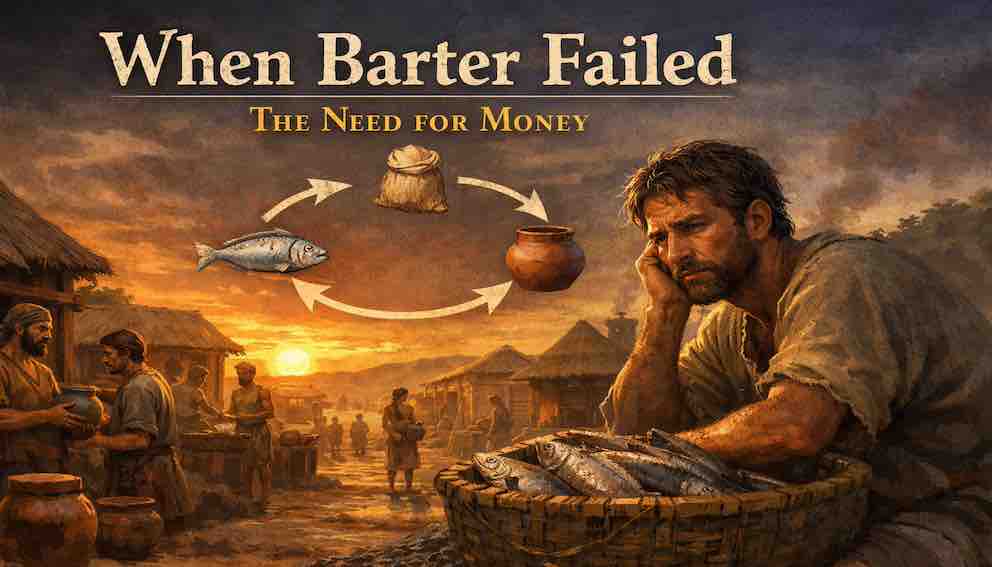
Before money existed, people could agree on value—but they could not hold it. Value had no physical form, no standard unit, and no way to move safely from today into the future.
What follows is not a story about bad markets or dishonest actors.
It is a story about settlement—what happens when payment is delayed but still expected, but there is nothing durable to carry the promise forward.
When Payment Had No Shape
The fisherman returned at dawn with more fish than his family could eat.
This was a good day. The sea had been generous. His nets were full. Nothing felt uncertain.
He knew exactly who would take the fish.
The grain farmer had done so many times before. There was no argument about value. No bargaining. Everyone understood what a basket of fish was worth.
“I’ll take it,” the farmer said.
“But payment will be after the harvest.”
That was normal. Fish came now. Grain came later.
The fisherman paused.
Once the fish left his hands, all that remained was a promise.
There was nothing to hold it in place—no record, no shared measure, no way to pass it to someone else if he needed something before harvest. No way to use it to settle another obligation in the meantime.
If he kept the fish, it would spoil.
If he gave it away, its value would exist only as memory.
By evening, the fish was gone.
The promise remained—already thinner than before.
Nothing dishonest had happened.
No one disagreed.
No one behaved badly.
And yet something had slipped through the cracks.
The Mathematics of Mistiming
What failed that day wasn’t effort or cooperation. Everyone was willing to trade. Everyone agreed on prices.
What failed was something quieter: value could not be carried forward once the moment passed.
The fisherman’s problem wasn’t finding someone who wanted fish. He already knew who did. The problem was that once the fish changed hands, nothing solid remained in his possession. No object, no record, no unit that could preserve what had been agreed.
Economists later gave this situation a name—the double coincidence of wants—but the lived experience was simpler. Value existed on both sides, just not at the same time, and there was no way to hold it steady in between.
As communities grew and work became specialized, this problem intensified.
Farmers produced in seasons. Fishermen produced daily. Potters worked when clay was ready. Toolmakers worked intermittently. Needs arrived constantly, but production arrived unevenly.
For an exchange to succeed, everything now had to line up at once:
- Goods had to be needed immediately
- Quantities had to align exactly
- Payment had to occur before value decayed
When those conditions failed, value didn’t vanish because it was unwanted. It vanished because it had nowhere to sit.
The village was not short of goods.
It was short of a way to hold value once agreement was reached.
Improvising a Container for Value
Under pressure, people improvised.
They didn’t solve the problem by passing fish around. They solved it by remembering.
Favors were noted. Obligations accumulated. A fisherman delivered food today knowing the return would come later, in a different form. Nothing changed hands except trust.
“Two baskets now, one sack after harvest.”
These promises lived in memory, reputation, and social standing. Everyone knew who had given and who still owed. Settlement was delayed, but it was understood.
For a time, this worked.
It worked because communities were small, lives overlapped, and memory was shared. Reputation enforced repayment. Forgetting carried consequences.
But as trade widened and obligations layered on top of each other, memory became fragile. Promises overlapped. Disputes multiplied. Trust existed—but it no longer had a stable container.
Trust needed help. That was the pressure that led to record-keeping.
Around 3000 BCE in Mesopotamia, temples stepped into that role. They didn’t invent money as an object of wealth. They created records.
Clay tokens and cuneiform tablets tracked obligations in standardized units of barley. These marks didn’t represent coins. They represented claims—recognized, transferable acknowledgments that value had been given and would be returned.
For the first time, a fisherman didn’t need to wait for harvest or rely on memory. He could hold something tangible that stood in for the promise. He could pass it to someone else. He could settle another obligation with it.
Value no longer had to be remembered.
It could be carried.
The system worked not because the clay had worth, but because people agreed on what it represented.
Money, in its earliest form, wasn’t about desire or accumulation.
It was about giving promises a shape.
That shift—from remembered obligations to transferable claims—marks the first true regime change in financial history. It’s the moment value learned how to move through time.
Relief Arrives Quietly
The change felt almost invisible.
The fisherman returned home lighter, calmer. His grain was secured. The farmer trusted the potter's tally. The potter trusted the sandal maker to honor it. No one declared, "We've invented money." They simply noticed, "This works."
Most financial innovations begin this way—not as ideology, but as habit. Money is social memory made portable.
By 2150 BCE in Mesopotamia, these tallies had materialized into silver shekels—standardized weights of metal that served as the region's currency for over a thousand years. The principle remained: a shared reference point that allowed plans to mesh without requiring perfect synchronization.
The Fragility Hiding in Plain Sight
But every coordination shortcut carries a hidden cost.
Once money exists, something subtle changes. People stop tracking who owes them and start tracking what is owed. Relationships gradually thin into balances. This is marvelously efficient—and quietly fragile.
The system hums as long as everyone believes the tally holds value. That belief becomes background noise, assumed rather than examined. This is money's central paradox: its greatest strength (efficiency) creates its deepest fragility (invisible, abstracted trust).
Stability feels natural—until the day someone questions whether the tally will be honored. Then, like the spoiled fish, value can vanish not through physical loss, but through broken coordination.
Conclusion: The Pattern Set in Clay
The fisherman's frustrating day established a pattern that would repeat for millennia:
- Money is coordination crystallized. It emerges to solve timing problems, not moral deficiencies. The double coincidence of wants isn't a flaw in human nature—it's a mathematical constraint of direct exchange.
- It packages trust for travel. Money transforms personal credibility into transferable tokens, allowing cooperation to extend beyond kinship and memory—from clay tallies to digital balances.
- Stability secretly breeds fragility. Systems work smoothly precisely because trust becomes invisible and assumed. This abstraction enables scale but masks vulnerability.
The Mesopotamian temple accountant marking clay tablets and the modern app user tapping a screen are solving the same fundamental problem: How do we coordinate with strangers when personal trust doesn't reach?
We didn't design money. We stumbled into it. And in doing so, we set in motion a cycle we're still navigating: build systems to scale trust, come to trust the systems themselves, then watch as they eventually break, reminding us of the human agreement at their core.
About Swati Sharma
Lead Editor at MyEyze, Economist & Finance Research WriterSwati Sharma is an economist with a Bachelor’s degree in Economics (Honours), CIPD Level 5 certification, and an MBA, and over 18 years of experience across management consulting, investment, and technology organizations. She specializes in research-driven financial education, focusing on economics, markets, and investor behavior, with a passion for making complex financial concepts clear, accurate, and accessible to a broad audience.
Disclaimer
This article is for educational purposes only and should not be interpreted as financial advice. Readers should consult a qualified financial professional before making investment decisions. Assistance from AI-powered generative tools was taken to format and improve language flow. While we strive for accuracy, this content may contain errors or omissions and should be independently verified.