
Tutorial Categories
Last Updated: January 24, 2026 at 10:30
What Makes Money Work — And Why It Eventually Fails - World Financial History Series
Money works when it solves coordination problems, and struggles when it no longer does. Across history, currencies have been shaped by three enduring questions: can value move easily, will it endure over time, and will others accept it without hesitation? From ancient trade to digital ledgers, this chapter shows how those tests define monetary survival—and why they are being applied again today.
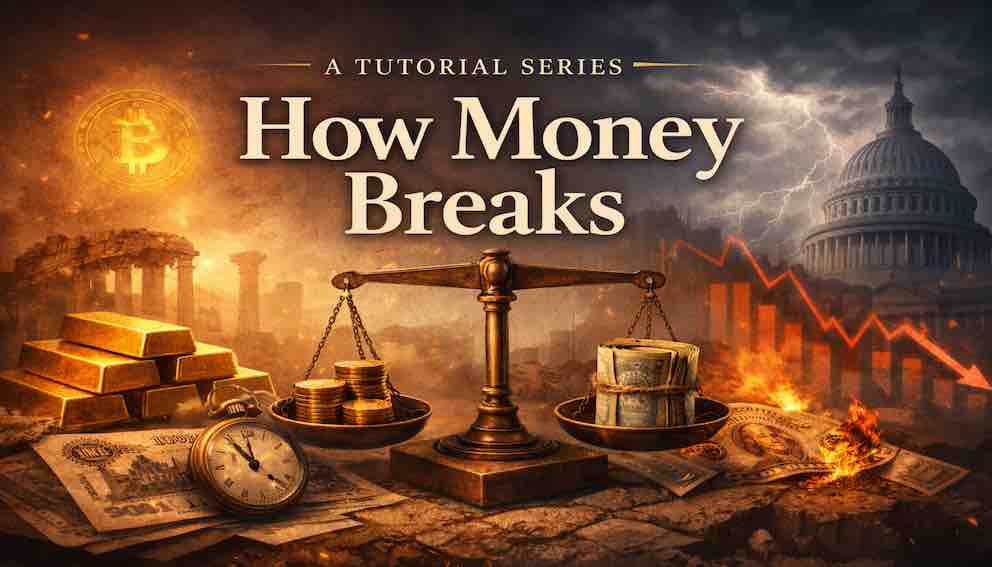
You’ve likely noticed it: the market keeps climbing, retirement accounts look healthy, but confidence in what those numbers actually secure has started to slip.
Inflation grinds low and steady, eating through savings a fraction at a time. Major powers begin settling oil and metals in yuan instead of dollars. Central banks, even Western ones, quietly accumulate gold after decades of selling it off. The global monetary system that once felt permanent starts to look… negotiable.
For now, daily life goes on. Supermarket tills still ring. Salaries still clear. Account balances still display neat totals.
But underneath that calm rhythm runs an older doubt:
What does my money really promise me—and how long will that promise hold?
That flicker of doubt links you with every merchant, miner, artisan, and banker who ever paused before completing a trade or accepting payment. Whether the unit was shells, silver, stamped paper, or encrypted code, people have always tested their money in the same practical way—by seeing whether it could solve three everyday problems.
Can it move?
Can I pass this on—to someone else, in another place, or at a later time—without it losing usefulness along the way?
Will it last?
Will this still represent value after storage, transport, or institutional handling—or does it depend on conditions that might quietly fail?
Will it be taken?
When I offer this in payment, will others accept it easily—or hesitate, negotiate, or demand something else?
Money doesn’t fail when it simply loses value.
It fails when it stops answering “yes” to these questions.
History is not a string of monetary inventions or revolutions. It is a record of old answers cracking under new pressures—when everyday life began asking harder versions of the same problems.
In the chapters ahead, we will return to these same questions and apply them to the world we live in now. Not to predict collapse or defend any particular system, but to see—calmly and clearly—where today’s answers still hold, and where they are beginning to strain.
For now, let’s trace how these questions first emerged.
Not as a timeline, but as a series of stress tests.
This is not a history of money’s forms, but of the problems money has been asked to solve as the world grew larger.
Stress Test #1: Tomorrow and the Stranger
Picture a small coastal village, long before coins or banks. A fisherman returns with a catch just starting to spoil. Others have grain, tools, or fabric to trade—but not now, not today.
Value exists everywhere.
Coordination does not.
This problem first appeared when early agricultural societies outgrew face-to-face exchange.
The question under pressure is simple:
Can it move?
Fish cannot. They perish. Trust, in a village of a hundred, is immediate and personal—but fragile. It doesn’t travel well beyond familiar faces in the village or across time.
So people reached for things that could move and last: shells, beads, cattle, later small lumps of metal. Not because they were beautiful or rare, but because they were salable—easy to pass along to someone else later.
This is how money first emerged. Not to store wealth, but to move value—to carry trust forward when direct reciprocity failed.
Modern echo:
This same logic explains why digital payment apps spread so quickly. We didn’t adopt them for the technology itself, but because they reduced coordination friction among people who don’t settle up immediately or face to face. They didn’t invent trust or value—but they made existing value easier to move across social distance, with a tap.
Stress Test #2: Distance and Doubt
As trade networks stretched across empires in the classical and medieval worlds, money faced a new problem.
As trade expanded, village trust dissolved. Merchants traveled across regions where faces were unfamiliar and customs varied.
A medieval trader moving from Venice to Antioch carried silver not just to make purchases, but to have it weighed, tested, and judged acceptable again and again along the route. Every town measured differently. Every exchange required scales, tests, negotiation.
The question shifted:
Will it be taken?
The stamped coin met that challenge. A ruler’s mark compressed local trust into a portable signal: weight, purity, recognition. The Athenian owl, the Roman denarius, the Islamic dinar, the Byzantine solidus—all performed the same coordination miracle.
Acceptance widened. Friction fell. Trade accelerated.
But not all experiments held. When rulers clipped edges or diluted silver, trust eroded quietly. Rome’s denarius lost its silver content over centuries, not overnight. Coins kept circulating—but belief thinned. People demanded more coins for the same goods. Calculation replaced confidence.
When acceptance is broad, money disappears into the background.
When acceptance narrows, money becomes visible again.
Modern echo:
Today, your money works without question for coffee, groceries, and gas. But try to move a large sum, send money abroad, or commit savings far into the future—and the ease disappears. Extra forms appear. Delays creep in. Fees and conditions multiply. The money is still accepted, but no longer without friction. That’s the modern return of the question: Will it be taken?
Stress Test #3: Scale and the Invisible Vault
By the early modern period, as nation-states and global trade emerged, physical money itself became the constraint.
By the 17th and 18th centuries, commerce stretched across oceans. Physical money, paradoxically, became too heavy for its own success.
Gold was durable—but dangerous to transport. At scale, the metal itself became a liability.
So paper promises emerged: bills of exchange, then banknotes—claims on value held elsewhere.
Now the system faced a new question:
Will it last?
Gold doesn’t rot or disappear. Paper money does—if the bank or government that promised redemption collapses. From this point on, money lasted only as long as people believed the issuer would still be there tomorrow.
The founding of the Bank of England in 1694 formalized that shift. Its notes were backed not only by metal, but by the credit and tax power of the state. Durability moved from the physical realm to the institutional one.
This was the moment a new, quieter question entered the system—one that often goes unasked until it matters:
Will this durability be protected, or abused?
That same question hovered in the background when countries suspended gold convertibility during wartime, when the gold standard was abandoned in the twentieth century, and when alternative settlement systems start to emerge today. Each time, the promise became easier to issue—and harder to limit.
When people believed those institutions would hold their promises, money made modern life possible—long-distance trade, loans, insurance, and large public projects.
When it wasn’t—France’s assignats, interwar Germany’s papiermarks—money collapsed faster than paper could be printed.
Modern echo:
Today, durability lives in databases, clearing systems, and policy credibility. We trust not the token, but the system operator. Most of the time, that trust is invisible. Until phrases like “bank failure,” “liquidity freeze,” or “settlement disruption” remind us that institutional durability is still made of belief—and belief, once strained, is hard to restore.
When Authority Meets Strain
From Rome’s debasement, to Byzantium’s discipline, to Bretton Woods’ temporary order, when a monetary system comes under strain, authority almost always steps in—not to invent something new, but to steady what already exists.
Sometimes that partnership works.
The Byzantine solidus kept its gold content for nearly seven centuries, anchoring trade across the Mediterranean. After World War II, the Bretton Woods system restored order by tying global currencies to the U.S. dollar—and indirectly to gold.
Other times, authority mistakes power for trust.
Rome debased its silver coinage while forbidding alternatives. In 1971, the United States severed the dollar’s link to gold, preserving short-term sovereignty while shifting the world toward pure fiat money.
Authority can prolong usefulness,
but it cannot fabricate it.
When command tries to replace utility, money still circulates—but reluctantly. It works where authority can see, and at a discount everywhere else.
The Digital Stress Test
After centuries of metal, paper, and institutional promises, money has now become information.
Ledger entries move at the speed of light, and value travels without weight or borders.
Yet the basic tests haven’t changed.
A central bank digital currency answers the question “Will it be taken?” with “The law says yes.”
A cryptocurrency answers “Can it move?” with an emphatic “Yes.”
Each system excels at one test. Each remains unproven on the others.
So the choice before us is not between “old” and “new” money. It is between different priorities. We are deciding which questions a system answers first—and which limitations we are willing to accept in return.
How Monetary Failure Actually Appears
Collapse is not an event. It’s a slow-motion erosion.
Movement slows as contracts shorten and savings flee.
Durability strains as authorities reassure more often than they reform.
Acceptance narrows—first quietly, then habitually.
By the time headlines announce a crisis, the diagnostic has been running for years—in behavior, not rhetoric. Weimar diaries, Soviet shops, Argentine barter networks all tell the same story: the quiet shift from confidence to calculation.
What Should Have Been Learned
That money survives by usefulness, not decree.
That trust is behavioral before it is verbal.
That stability hides fragility until scale exposes it.
That money fails quietly long before it fails loudly.
What Was Actually Learned
That authority could manage confidence.
That technical fixes could replace trust.
That systems that once worked would keep working.
Those lessons make sense—until reality asks harder questions.
A Simple Note on Trust
It’s common to say that money runs on trust. That’s true, but incomplete. Trust only matters because of what it allows people to do.
Trust determines how easily money moves. When trust is high, money flows across borders and through systems without friction. When it weakens, controls appear, transfers slow, and workarounds become normal. The dollar still moves—but less freely than before. That’s trust showing up as reduced ability to move value across space and scale.
Trust also determines whether money lasts. People don’t usually say, “I distrust this currency.” They say, “I don’t want to hold it for long.” That’s not a belief—it’s a choice. When money printing accelerates or rules change often, people start doubting whether tomorrow’s promise will match today’s. That’s a durability problem.
Trust decides whether money is accepted without hesitation. Acceptance isn’t about laws; it’s about ease. When trust thins, transactions gain conditions: “We take this, but not for that.” “We take it, but at today’s rate.” This isn’t a new question appearing. It’s acceptance narrowing.
So trust isn’t a fourth question added to the framework. It’s the background condition that keeps the answers to the three questions stable.
This is also why debates about fiat money miss the point. Fiat systems don’t fail because people suddenly lose faith. They fail when behavior slowly changes—when money still works, but only with more rules, more friction, and more caution.
The same logic applies to new forms of money. Assets don’t become money because they are innovative or scarce. They become money if people can move them easily, rely on them over time, and accept them without hesitation—especially among strangers.
That’s the test. It’s always been the test.
And its answers are never final.
A Quiet Modern Echo
When people notice the dollar index slipping, gold hitting record highs, or governments talking about currency blocs, they aren’t witnessing something unprecedented. They’re watching familiar stress tests play out with new tools.
And when you hesitate—about holding too much cash, or not enough—you’re taking part in the oldest economic ritual there is: testing whether your money will still make sense tomorrow.
The fisherman, in the previous chapter, needed tomorrow to work.
So do we.
The forms of money will keep changing.
The questions will not.
Our task isn’t to predict what comes next.
It’s to notice when the old answers begin to fade.
Conclusion
What this history offers is not a prediction, but a way of seeing. Once you notice the questions money must answer, you start to see them everywhere—in policy debates, in new technologies, in your own small hesitations. The surface keeps changing. The tests underneath do not. And long before money fails outright, it tells us—quietly—when its answers are starting to wear thin.
About Swati Sharma
Lead Editor at MyEyze, Economist & Finance Research WriterSwati Sharma is an economist with a Bachelor’s degree in Economics (Honours), CIPD Level 5 certification, and an MBA, and over 18 years of experience across management consulting, investment, and technology organizations. She specializes in research-driven financial education, focusing on economics, markets, and investor behavior, with a passion for making complex financial concepts clear, accurate, and accessible to a broad audience.
Disclaimer
This article is for educational purposes only and should not be interpreted as financial advice. Readers should consult a qualified financial professional before making investment decisions. Assistance from AI-powered generative tools was taken to format and improve language flow. While we strive for accuracy, this content may contain errors or omissions and should be independently verified.