
Tutorial Categories
Last Updated: January 27, 2026 at 10:30
Wealth, Power, and the Recurring Cycle of Inequality - World Financial History Series
Wealth inequality has appeared again and again in financial history, and people have noticed it every time. They argued about it, warned about it, and tried to fix it through reform, law, and moral pressure. Those efforts usually helped for a while, but they did not last, because the same systems that keep markets stable also protect some people from catastrophic loss more than others. Over time, that protection allows wealth to accumulate near power, even without bad intentions. When inequality grows too large, it is not corrected gently, but reset through crisis, inflation, war, or reform, and the cycle begins again.
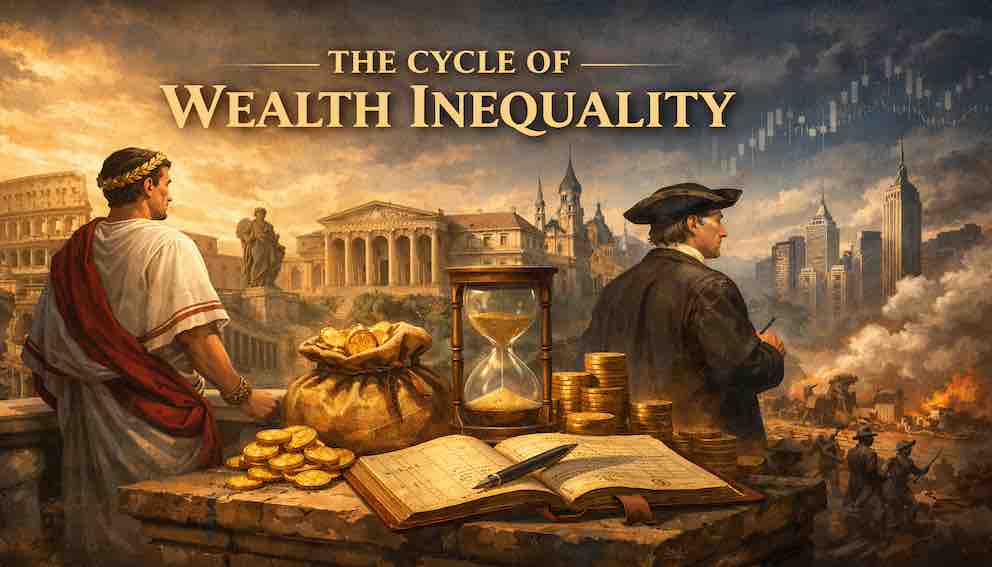
Wealth inequality has appeared again and again throughout financial history, and people have recognized it each time. They debated it, warned about its dangers, and tried to limit it through laws, reforms, and moral appeals. Often, these efforts worked for a while. Living conditions improved. Social tensions eased. But the improvement rarely lasted. This is because the same systems built to keep markets running and governments financially stable also protect some people from total financial ruin more than others. Over time, that uneven protection allows wealth to collect around those closest to power, even when no one is acting out of greed or bad intent.
When inequality becomes large enough, it is rarely reduced in a calm or gradual way. Instead, it is usually corrected through disruption. Inflation weakens old debts. Wars wipe out property and financial claims. Revolutions seize wealth outright. Sometimes major reforms are forced through under extreme pressure. After this kind of reset, a new system takes shape. Economic opportunity returns. Stability is restored. And slowly—often so quietly that few notice—the same pattern begins again.
You can see this pattern reflected again and again in history. Walk through the ruins of a Roman villa or past the ornate homes of Renaissance bankers, and you are looking at the long-term result of how wealth responds to risk. Wealth does not remain evenly spread. It shifts over time toward people and institutions that are better protected from catastrophic loss. Those protections may come from legal privilege, political access, or influence over how financial rules are written and enforced.
Across centuries and across very different societies, from agricultural empires to modern financial states, inequality has grown in similar ways for the same reason. Some people are exposed to failure that can erase everything they own, while others are shielded from that kind of ruin. This difference in exposure shapes behavior, opportunity, and outcomes. Seen this way, inequality is not mainly a story about good or bad character. It is a structural story about who carries the risk in an uncertain world, who is protected from its worst consequences, and how societies organize economic survival over time.
Seeing the Pattern, Again and Again
As long as people have kept records, they have recognized this pattern and argued about it openly. Roman speakers accused senators of swallowing up small family farms and turning them into vast estates. Medieval preachers warned that merchants who clustered around royal courts were growing rich under special protection. Enlightenment thinkers cautioned that monopoly and inherited privilege weakened republics from within. Today, economists trace rising wealth concentration with detailed data and renewed concern. The language has changed, but the unease has remained the same.
The warning has always been clear. So have the responses. Societies have tried redistribution, regulation, and moral reform. Many of these efforts were genuine. Some worked for a time. Conditions improved, and tensions eased. Yet the pattern kept returning. This persistence is not because people failed to notice what was happening. It is because of when inequality grows most strongly.
Inequality tends to deepen during periods that feel successful. When markets are expanding, jobs are available, and crises seem far away, the systems that quietly advantage some groups over others are praised as sources of stability. They appear to be working. Only later, when trust begins to erode and social cohesion weakens, does the accumulated imbalance become visible and politically dangerous.
To understand why wealth repeatedly gathers near power, we have to look beneath visible fortunes and ask a simpler, more revealing question: when the system comes under stress, who is protected from complete financial ruin, and who is not?
Rome: Land, Law, and Unequal Exposure to Loss
Consider the Roman Republic in the centuries before it became an empire. Its economy rested on small landholding farmers. These citizens worked their own plots and served as soldiers in Rome’s armies. Their lives were shaped by ordinary risks that could still be devastating. A drought, an illness, military service that kept them from their fields, or a single failed harvest could push a family into crisis. When that happened, they borrowed money simply to survive.
Roman law offered little mercy. The rules governing debt were written and enforced by the landowning elite. If a farmer could not repay what he owed, he lost his land. In the most severe cases, he could lose his freedom as well. A temporary setback could erase an entire way of life.
Now compare this situation with that of a Roman senator. He also owned land. He also faced poor harvests and economic uncertainty. But his exposure to loss was fundamentally different. He helped shape the laws that governed debt and property. He knew the magistrates who interpreted and enforced those laws. When trouble arose, he had options. Judgments could be delayed. Terms could be renegotiated. Political alliances could be called upon. Where a farmer faced total ruin, a senator faced inconvenience.
Over time, this difference mattered more than any single decision. Generation after generation, small farms were absorbed into large estates, known as latifundia. Displaced farmers moved into the city of Rome, forming a growing urban population that depended on grain distributions and political patronage to survive. Wealth had not simply increased. It had become firmly tied to political position and legal authority.
Some Romans understood the danger. In the second century BC, the Gracchi brothers proposed redistributing public land to restore independent farmers and strengthen Rome’s citizen army. Their reforms passed and brought temporary relief. But they did not change the deeper structure of the system. The political and legal insulation that protected elites from catastrophic loss remained intact. The aristocracy adjusted its behavior. Wealth concentration resumed. Both brothers were eventually killed, and Rome absorbed a recurring lesson of financial history: redistribution can ease pressure and buy time, but on its own, it cannot undo systems built around unequal protection from ruin.
Court Finance: Proximity as Protection
The same basic logic appeared again centuries later in early modern Europe. Kingdoms were almost constantly at war, and war was expensive. Rulers needed large sums of money quickly, far faster than their crude tax systems could reliably deliver. To survive, they turned to merchants and bankers, families such as the Medici of Florence or the Fuggers of Augsburg, who could advance funds to the crown when it was most needed.
These financiers did take real risks. Kings could default on their debts, and many did. A lost war could erase years of lending. But court financiers gained something that ordinary merchants did not have: close access to political power. That access acted as a form of protection. Their loans were often secured against future tax revenues. They received exclusive monopolies over valuable trades or resources. In many cases, financial claims were transformed into noble titles, tying private wealth directly to the survival of the state.
When financial crises arrived, governments had strong incentives to protect these primary creditors. If court financiers failed, the state itself could lose access to funding. As a result, losses were frequently shifted away from those closest to power and onto others. Inflation reduced the real value of debts. Payments were delayed. Smaller or less connected creditors absorbed defaults. Those without political leverage bore the cost.
Over time, wealth visibly accumulated around royal courts and capital cities. This was not because court financiers were more virtuous or more clever than other merchants. It was because their failure posed a direct threat to the functioning of the state. Critics at the time understood this. Moralists condemned excess and luxury. Religious authorities revisited long-standing bans on usury. Yet the system endured because it solved an existential problem for rulers: how to fund sovereignty itself. Inequality was not the objective, but it became an unavoidable byproduct of survival.
Modern Finance: Liquidity and the Institutionalization of Protection
Industrialization and the rise of modern financial markets did not remove this pattern. They made it more efficient. Wealth was no longer held mainly in land or physical goods. It increasingly took the form of financial assets such as stocks, bonds, and claims on future income. As a result, the main economic danger also changed. The greatest risk was no longer a failed harvest or a king’s default, but a systemic collapse—moments when confidence disappears and many asset prices fall at the same time.
In this environment, protection takes on a new and more technical form: liquidity. During financial crises, central banks create money and credit to keep the system from seizing up. They lend against weakened collateral, lower interest rates, and buy assets to prevent forced selling. During the 2008 financial crisis, these tools were used on a massive scale. Banks were supported. Key markets were stabilized. The economy avoided a deeper collapse. At the same time, specific balance sheets were protected from complete failure.
This protection was not primarily about favoritism or corruption. It followed the practical logic of crisis management. Large and highly interconnected institutions were supported first because their collapse would have spread damage throughout the system. Their assets, even when impaired, were accepted as collateral. Smaller actors—households, small businesses, and workers—entered the downturn with far fewer safeguards and much less access to emergency support.
The consequences unfold quietly but persistently. Financial assets tend to recover faster than wages or employment. Wealth rebounds before income. Those who already own assets benefit most from policies designed to stabilize the system as a whole. Over time, this protection becomes embedded. Regulations are written with crisis survival in mind. Legal precedents are set. Political influence grows alongside preserved wealth. Wealth finances advocacy. Advocacy shapes rules. And those rules, in turn, encode future protection from loss.
Participation and Legitimacy
One reason this system endures is that many people benefit indirectly during stable periods. Cheap credit, rising home values, pension growth, and employment tied to expanding markets all create buy-in. Inequality feels abstract when stability feels real. Only when growth falters do the underlying asymmetries become visible.
Reform, Reset, and Recurrence
Warnings are almost always present, but meaningful reform usually arrives late. When reform does occur, it often focuses on the most visible results of inequality rather than its deeper causes. Progressive taxation, antitrust laws, and financial regulation can limit excess and improve fairness. These measures matter, and they have improved many lives. But they rarely change the central question of the system: who is protected from complete financial ruin when severe stress hits.
When reform cannot keep pace and inequality stretches social trust to its breaking point, history suggests that more forceful mechanisms take over. Inflation reduces the real value of debts. Revolutions seize property outright. Wars destroy capital and reset ownership through devastation. These events are brutally effective at reducing inequality, but they come at an enormous human cost. And when the rebuilding begins, new systems are designed to restore stability. In doing so, they once again create layers of protection—setting the stage for a new cycle of unequal risk and reward.
Seeing Clearly, Not Cynically
This recurring cycle of inequality is not a law of nature, but it is a common result of how societies choose to organize finance and authority. Stability does not arise on its own. It requires institutions and people to guard against collapse. Those guardians are given protection so they can do their job. Over time, that protection turns into wealth. And as wealth accumulates, it gradually hardens into lasting power.
Recognizing this pattern does not require cynicism or resignation. It requires clarity. It asks us to move away from moral blame and toward questions of structure and design. Who is insulated from total ruin when the system is under stress? Who is exposed to losses that can erase everything? Financial history suggests that inequality is rarely an accident. It is often the residue left behind by ongoing efforts to manage risk and maintain stability.
Seeing the pattern clearly is the first step toward changing it. The cycle may be ancient, but it is not fixed forever. Each generation inherits these systems as they are, and each generation—through its choices, reforms, and tolerances—decides how much of the cycle to carry forward, and how much to reshape.
About Swati Sharma
Lead Editor at MyEyze, Economist & Finance Research WriterSwati Sharma is an economist with a Bachelor’s degree in Economics (Honours), CIPD Level 5 certification, and an MBA, and over 18 years of experience across management consulting, investment, and technology organizations. She specializes in research-driven financial education, focusing on economics, markets, and investor behavior, with a passion for making complex financial concepts clear, accurate, and accessible to a broad audience.
Disclaimer
This article is for educational purposes only and should not be interpreted as financial advice. Readers should consult a qualified financial professional before making investment decisions. Assistance from AI-powered generative tools was taken to format and improve language flow. While we strive for accuracy, this content may contain errors or omissions and should be independently verified.