
Tutorial Categories
Last Updated: January 27, 2026 at 10:30
How States Manage Inequality Without Breaking the System - World Financial History Series
Modern states do not eliminate inequality because doing so would damage the financial systems they rely on to function. Instead, they manage it quietly—by defining what counts as economic risk, stabilizing markets before collapse, redistributing just enough to reduce pressure, and shaping narratives that make outcomes feel acceptable. These tools work not because they are fair, but because they preserve coordination, trust, and political order. Over time, however, stability allows hidden stresses and inequality to build beneath the surface. History shows that this tension is not resolved, only delayed—until it is released through crisis, inflation, reform, or conflict.
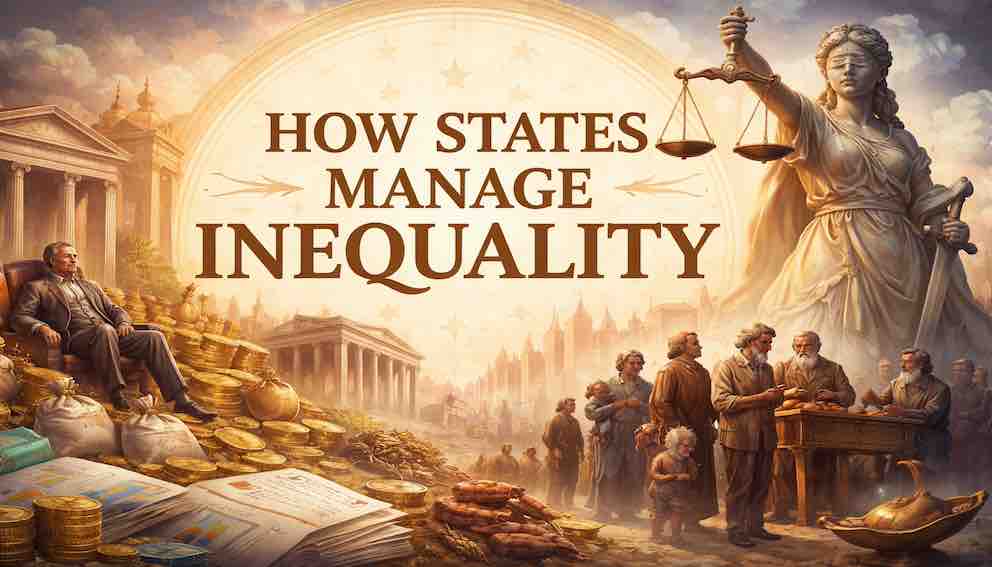
A mosaic floor unearthed from a Roman villa tells one story. It shows scenes of commerce, leisure, and abundance. A few miles away, a mass grave discovered by archaeologists tells another. It holds the remains of those who labored on the great estates, who borrowed to survive, and who were buried without ceremony when the debts came due.
The true history of inequality is written not in the proclamations of emperors, but in the quiet space between these two sites—between the power that builds systems and the people who live, strain, and often collapse within them.
By this point in our story, a difficult pattern should be clear. Financial systems, for all their ingenuity, do not distribute risk or reward evenly. Those closest to political and institutional power tend to have their wealth protected, especially during moments of stress. Others are exposed to the full force of failure. This is not a rare malfunction. It is a recurring feature of how complex societies coordinate economic life.
This realization forces a more practical question. If the state itself is both a product of this system and its ultimate guardian, what can it realistically do? It cannot dismantle the machinery of finance without starving itself of the credit, taxation, and coordination that sustain its authority. Yet it cannot ignore the political instability, loss of legitimacy, and social fracture that extreme inequality inevitably produces.
History’s answer is not a grand solution. It is a continuous, quiet act of engineering. States do not eliminate inequality. They manage it. They redistribute enough to relieve pressure, stabilize enough to prevent collapse, and tell stories compelling enough to make the arrangement feel tolerable. This is the uncelebrated craft of governance: maintaining a system that naturally generates strain without allowing that strain to snap the system itself.
The Art of Seeing: How States Invent the “Economy” They Govern
Before a state can manage inequality, it must first decide what it is actually managing. This is the most basic—and most overlooked—form of power.
In everyday life, there is no single, coherent “economy.” There are transactions, favors, debts, harvests, wages, and risks scattered across millions of individual lives. Left alone, this reality is too complex for centralized control. The state’s first task, therefore, is to simplify it.
This is done through measurement and classification. The Roman census was an early example. It did more than count citizens for military service. It catalogued land, slaves, and livestock, turning personal wealth into legible data. By measuring, Rome could tax, conscript, and plan. From countless private lives, it constructed a single object it could govern: the Roman economy.
This act of measurement is never neutral. What a state chooses to count determines what it can see, and what it can see determines what it can manage. When early modern English officials began tracking grain prices, they were not engaged in abstract scholarship. They were trying to anticipate bread riots and political unrest. The “economy” they cared about was defined by the price of food.
In the modern world, this process has become highly abstract. GDP compresses the vast complexity of national life into a single number. Inflation indices turn lived experience into statistical averages. When regulators label a bank “systemically important,” they are not simply describing reality. They are making a political decision, backed by mathematics, that this institution will receive priority support in a crisis.
The consequence is profound. The state ends up managing the economy as it has defined it. It stabilizes GDP, not necessarily household security. It rescues systemically important institutions, not necessarily everyone affected by their failure. Risks that fall outside official categories—rising household debt, precarious employment, shadow finance—often remain invisible until they explode.
The first and most powerful tool for managing inequality, then, is deciding what even counts as a problem.
Redistribution as Maintenance, Not Justice
Once the economy has been made legible, states can intervene directly. The oldest and most obvious tool is redistribution.
In the Roman Republic of the second century BC, land—the foundation of wealth and military power—was rapidly concentrating among elites. Small farmers were pushed off their plots, flooding Rome with landless citizens dependent on irregular work and public grain.
The Gracchi brothers are often remembered as radicals. In reality, they were system managers. They understood that an army of landless citizens was militarily weak, and a city full of desperate men was politically dangerous. Their land reforms aimed to redistribute just enough public land to restore a stable, property-owning citizenry. The goal was not equality. It was durability.
The reforms relieved pressure temporarily, but they did not alter the underlying structure. The legal system continued to favor large landholders. Political power remained insulated from catastrophic loss. The Gracchi were killed, and the reforms were slowly dismantled. Rome had learned a lesson it would repeat for centuries: redistribution can stabilize a system, but it cannot rewrite its rules.
This pattern appears again and again. Elizabethan poor laws, post-revolutionary land reforms, and modern welfare states all emerged from similar calculations. Otto von Bismarck was explicit when he introduced social insurance in 19th-century Germany. It was cheaper than revolution and more predictable than unrest. Redistribution was not a moral concession; it was a maintenance cost.
This pattern appears repeatedly across financial and political history. In Elizabethan England, the Poor Laws were introduced not because poverty was newly discovered, but because vagrancy and unrest were becoming expensive and destabilizing for local authorities. After major revolutions, land reforms followed the same logic: elites conceded limited redistribution to prevent repeated uprisings and to anchor populations back into predictable economic roles. In the late 19th century, Otto von Bismarck made this reasoning unusually explicit when he introduced social insurance in Germany. He argued that providing workers with pensions and protections would cost the state less than facing continual strikes, radical movements, or the risk of revolution. In each case, redistribution was not framed as a moral awakening, but as a practical expense—paid to preserve order, reduce uncertainty, and keep the broader system functioning.
Stabilization, Liquidity, and the Entrenchment of Advantage
As financial systems became more liquid, a new danger emerged. Liquidity makes assets easy to trade, but it also makes panic contagious. When everyone can exit at once, collapse spreads quickly.
The Panic of 1907 demonstrated this vividly. Trust vanished almost overnight. Banks that held long-term loans could not meet short-term withdrawals. The system froze. It was rescued not by the state, but by J.P. Morgan, who coordinated a private bailout to stop the chain reaction.
The lesson was unmistakable. A liquid financial system cannot survive without a backstop. This realization led to the creation of central banks as lenders of last resort. Crisis management became a public responsibility.
Over time, these emergency tools did not remain exceptional. Once a state commits to stopping collapse, it cannot easily step back. Liquidity provision, market support, and financial regulation gradually become permanent features of governance. Crisis management turns into everyday economic management.
This creates a dilemma. To stop a panic, the state must supply liquidity to the institutions at the center of the system. In modern crises, this means large banks and financial intermediaries. In 2008, these institutions received support because their failure would have destroyed the broader economy.
The logic is sound. But the consequence is structural inequality. Those with priority access to liquidity during crises see their losses absorbed and their assets preserved. Others do not. Inequality is not created in these moments, but it is locked in and magnified.
Stabilization reduces visible crises, but it allows inequality to compound quietly. Over time, this concentration increases fragility, making the system more dependent on even larger interventions in the future.
Narrative as a Technology of Consent
Material tools on their own cannot sustain an unequal system. People also need explanations that help them understand why outcomes look the way they do and why they should accept them. Without those explanations, redistribution, taxation, and crisis interventions appear arbitrary, and resentment builds quickly.
Across history, inequality has been justified through recurring stories. Sometimes it is presented as divine order, sometimes as natural hierarchy, later as social Darwinism, and today most often as meritocracy. Each version performs the same task: it makes unequal outcomes feel legitimate, stable, and predictable rather than the result of design or protection.
Meritocracy is especially effective because it is not entirely false. Individual effort and talent do influence outcomes. But the story quietly shifts attention away from structural advantages, inherited security, and institutional protection, and places responsibility on the individual. Success comes to feel earned in full, while failure appears personal rather than systemic.
These narratives are not crude deceptions. They are simplifying frameworks that allow complex and unequal systems to operate without constant challenge. They make redistribution appear as generosity rather than maintenance, and financial rescues appear as saving the economy rather than shielding concentrated power. Narrative, in this sense, is the psychological glue that allows material management to hold.
What History Taught—and What It Didn’t
History taught states that inequality must be managed, not ignored.
It taught them that liquidity crises must be stopped quickly.
It taught them that redistribution can stabilize but not transform.
What history did not teach them is how to exit these tools cleanly. Emergency measures become permanent. Stabilization entrenches advantage. Measurement blinds as much as it reveals.
The result is a repeating loop: stabilization suppresses crisis, inequality compounds, fragility increases, and intervention grows larger.
The Unending Task
So how do states manage inequality? They define it into existence, redistribute just enough to reduce pressure, stabilize the most dangerous failures, and tell stories that make the arrangement livable. They are not solving a problem. They are administering a condition.
This is the sobering lesson of financial history. Political debates over taxes and welfare are not struggles over final justice. They are negotiations over the settings of a vast, quiet machine designed to buy time.
The cycle does not end because the state, embedded within the system it protects, cannot afford to let it end. It can only delay the moment when managed pressures exceed the strength of its tools.
When that happens, history turns its page—not with policy papers, but with defaults, devaluations, reforms, or revolutions. The managers, for all their numbers and narratives, are never solving time. They are only borrowing it.
About Swati Sharma
Lead Editor at MyEyze, Economist & Finance Research WriterSwati Sharma is an economist with a Bachelor’s degree in Economics (Honours), CIPD Level 5 certification, and an MBA, and over 18 years of experience across management consulting, investment, and technology organizations. She specializes in research-driven financial education, focusing on economics, markets, and investor behavior, with a passion for making complex financial concepts clear, accurate, and accessible to a broad audience.
Disclaimer
This article is for educational purposes only and should not be interpreted as financial advice. Readers should consult a qualified financial professional before making investment decisions. Assistance from AI-powered generative tools was taken to format and improve language flow. While we strive for accuracy, this content may contain errors or omissions and should be independently verified.