
Tutorial Categories
Last Updated: February 10, 2026 at 19:30
Understanding Bond Liquidity: Why Not All Bonds Trade Equally
In bonds, the price you see is rarely the price you get. Unlike stocks, most bonds trade in opaque, over-the-counter markets where liquidity—the ease of buying or selling—varies dramatically. This tutorial explains how bid–ask spreads act as a hidden transaction cost, why even safe bonds can become difficult to sell in a crisis, and how bond ETFs can create an illusion of liquidity. You will also learn the factors that determine a bond’s liquidity and how market depth and stress events influence trading costs. By the end, you’ll be equipped to factor liquidity into your investment decisions, protecting your portfolio from unexpected losses.
Introduction: The "For Sale" Sign That No One Sees
Imagine you need to sell a car. A popular sedan like a Honda Civic will sell quickly at a predictable price, almost anywhere. Your rare, custom-built kit car? You might wait months and still be forced to accept a lowball offer. Liquidity is the “marketability” of an asset, or how easily it can be converted into cash at a fair price.
In the bond world, most investments are more like a kit car than a Civic. They rarely sit on a public lot—an exchange—where buyers can instantly see prices and transact. Instead, most bonds trade through private negotiations between dealers and brokers in over-the-counter (OTC) markets.
As a result, pricing depends not just on the bond itself, but on liquidity: how actively it trades, the size of the transaction, and how easily a buyer can be found. Two investors can hold the same bond and transact at meaningfully different prices on the same day, especially in less liquid markets or during periods of stress. Understanding this hidden dimension is what separates theoretical bond investing from practical, real-world investing.
Part 1: The Over-the-Counter (OTC) Marketplace – No Tickertape, Just Phone Calls
Forget the flashing tickers of the stock exchange. The vast bond market operates as a global web of private dealers and brokers. Prices are not broadcast to the public. Instead, if you want to buy a specific corporate bond, your broker will call or message several market maker desks—often large banks or specialized trading firms—to ask for quotes.
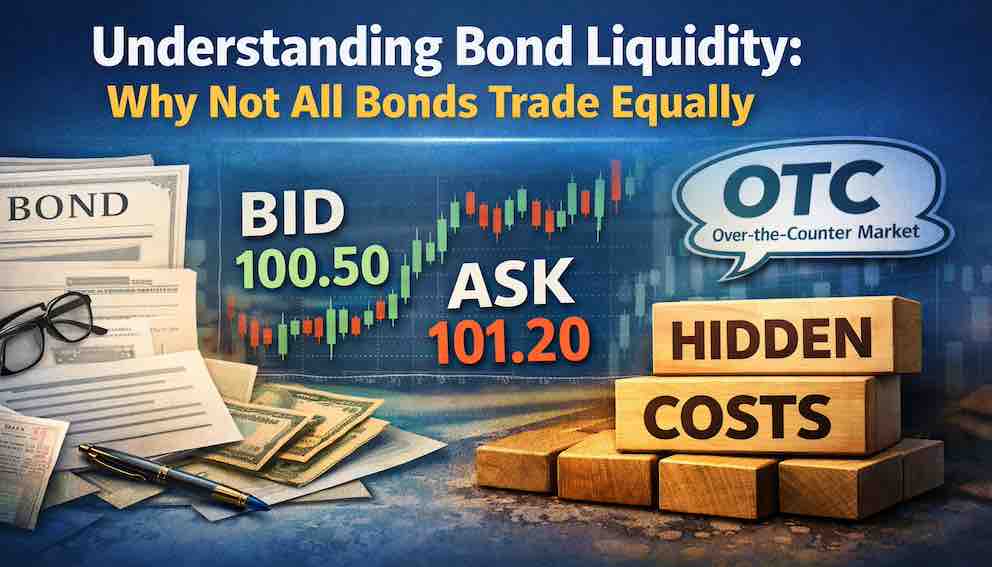
Each dealer provides a two-way price: what they are willing to pay to buy the bond from you (the bid) and what you must pay to buy it from them (the ask or offer). These prices reflect not only the bond’s underlying creditworthiness but also the dealer’s assessment of market demand, risk, and the cost of holding the bond until a buyer can be found.
A Relatable Scenario:
Imagine buying a concert ticket from a reseller. You check three sites: StubHub, Vivid Seats, and a fan forum. Each lists a slightly different “ask” price. If you suddenly need to sell your ticket, each site gives you a different, lower “bid” price. The bond market works the same way, but the stakes are far higher—often millions of dollars—and the negotiation is more nuanced.
Part 2: The Bid-Ask Spread – Your Invisible Transaction Fee
One of the most tangible measures of bond liquidity is the bid-ask spread, the difference between what a dealer is willing to pay for a bond (bid) and what they charge to sell it (ask).
Unlike a commission, the bid-ask spread compensates dealers for the risk of holding the bond and the potential difficulty of finding a counterparty. The spread is effectively the cost of immediacy—what you pay to exit or enter a position quickly.
Examples:
- Tight Spread (High Liquidity): U.S. Treasury Bond – Bid = $99.98, Ask = $100.00 → Spread = $0.02. Deep market, high certainty.
- Wide Spread (Low Liquidity): Small Corporate Bond – Bid = $97.00, Ask = $100.00 → Spread = $3.00. Dealer wary of being stuck with the bond.
Why This Matters:
If you buy the corporate bond at $100 and immediately change your mind, the dealer will only buy it back at $97. You’ve lost 3% of your capital instantly, even though the bond’s credit quality hasn’t changed. On a $10,000 trade, that’s a $300 cost. On a $1 million trade, it’s $30,000. This illustrates that liquidity risk scales with trade size.
Part 3: Factors That Determine Bond Liquidity
Not all bonds are created equal in terms of liquidity. Several factors consistently influence how easy it is to buy or sell a bond at a fair price:
- Issuer Type: Government bonds (e.g., U.S. Treasuries) are highly liquid, while small corporate or municipal bonds may trade infrequently.
- Issue Size: Larger issues generally attract more investors and market makers, improving liquidity. Small issues may see wide spreads and irregular trading.
- Time to Maturity: Bonds closer to maturity are sometimes easier to trade, especially if widely held. Very long-term or “off-the-run” bonds can be less liquid.
- Market Environment: Calm periods see tight spreads; during economic stress or crises, liquidity evaporates.
Liquidity Spectrum (Descriptive Alternative to a Table):
- High Liquidity: U.S. Treasuries, top-rated corporate bonds; narrow spreads, consistent trading volume.
- Moderate Liquidity: Mid-sized corporate bonds, municipal bonds; occasional trading gaps, spreads wider.
- Low Liquidity: Small corporate issues, niche bonds; infrequent trades, spreads wide, market depth shallow.
Understanding these factors helps investors anticipate hidden costs before committing capital.
Part 4: Liquidity Under Stress – When the Exits Shrink
Liquidity is not static. It evaporates in crises, often when it is needed most. Dealers protect themselves by widening spreads or temporarily withdrawing from the market.
Historical Vignette: March 2020
At the start of the COVID-19 pandemic, fear surged. Even high-quality, investment-grade corporate bonds, normally trading with tight spreads, experienced enormous gaps. Dealers, overwhelmed by sell orders and uncertain about underlying risks, quoted prices far below normal market value. Investors forced to sell suffered a liquidity penalty on top of price declines. This starkly demonstrated that a bond’s apparent safety can disappear under extreme conditions.
Another critical concept here is market depth—how much of a bond can be traded at current prices without moving the market. Even if a bond trades daily, trying to sell a large position can dramatically push the price down if the market depth is shallow.
Part 5: Bond ETFs – The Liquidity Illusion
Bond ETFs seem to solve liquidity problems. They trade on exchanges with tiny spreads, giving the appearance of seamless tradability. However, ETF liquidity does not equal bond liquidity.
- Underlying Bonds: The ETF holds a basket of sometimes illiquid bonds.
- Authorized Participants (APs): In normal markets, APs create or redeem shares to keep ETF price close to net asset value (NAV).
- Stress Events: If underlying bonds become difficult to trade or value, APs may step back. ETF shares can then trade at a persistent discount or premium to NAV.
Analogy:
An ETF is like a mutual fund that trades like a stock. You can exit the fund instantly, but during a crisis, you might be selling “shares” backed by illiquid assets at a fire-sale price. This is an illusion of liquidity, not true liquidity.
Part 6: Practical Guide to Navigating Liquidity
Here’s how investors can apply these lessons:
Interpret the Spread: Ask your broker for live bid-ask quotes. Spreads wider than ~0.5% for corporate bonds signal higher hidden costs.
Align Liquidity with Goals:
- Short-term needs (next-year expenses): Stick to highly liquid securities like Treasuries or top-tier bond funds.
- Long-term buy-and-hold: Smaller, less liquid bonds are acceptable if held patiently; higher yield compensates for illiquidity.
Use ETFs Intelligently: ETFs offer diversification and ease of trading but remember underlying liquidity risks in stress periods.
Beware the Liquidity Mismatch: Avoid funding short-term needs with long-term, illiquid bonds; the cost to exit can outweigh extra yield.
Consider Market Depth: For large trades, check how much volume can be absorbed without moving the price significantly.
Conclusion & Mental Model: The "Immediacy Premium"
Liquidity is the silent cost of bond investing. The key mental model is:
- Immediacy has a price: Bonds that can be sold instantly at predictable prices offer low yields (e.g., Treasury bills).
- Patience has a reward: Bonds with uncertain exit prices compensate investors with higher yields (the illiquidity premium, e.g., small corporates or certain municipals).
Liquidity is not a minor technicality. It shapes the true cost, risk, and return of your portfolio. By seeing the bid-ask spread as a real cost, understanding market depth, and aligning bond choices with your time horizon, liquidity becomes a managed part of strategy, not a hidden trap.
Investors who internalize these lessons stop being surprised by the market. They understand that a bond’s value is not just its promised cash flows, but the ease and cost of converting those promises into cash today. Recognizing liquidity as a fundamental principle transforms how we think about bonds—from theoretical contracts to real-world tools that must be navigated with knowledge, patience, and strategy.
About Swati Sharma
Lead Editor at MyEyze, Economist & Finance Research WriterSwati Sharma is an economist with a Bachelor’s degree in Economics (Honours), CIPD Level 5 certification, and an MBA, and over 18 years of experience across management consulting, investment, and technology organizations. She specializes in research-driven financial education, focusing on economics, markets, and investor behavior, with a passion for making complex financial concepts clear, accurate, and accessible to a broad audience.
Disclaimer
This article is for educational purposes only and should not be interpreted as financial advice. Readers should consult a qualified financial professional before making investment decisions. Assistance from AI-powered generative tools was taken to format and improve language flow. While we strive for accuracy, this content may contain errors or omissions and should be independently verified.