
Tutorial Categories
Last Updated: February 10, 2026 at 19:30
Embedded Options: Callable, Puttable, and Convertible Bonds
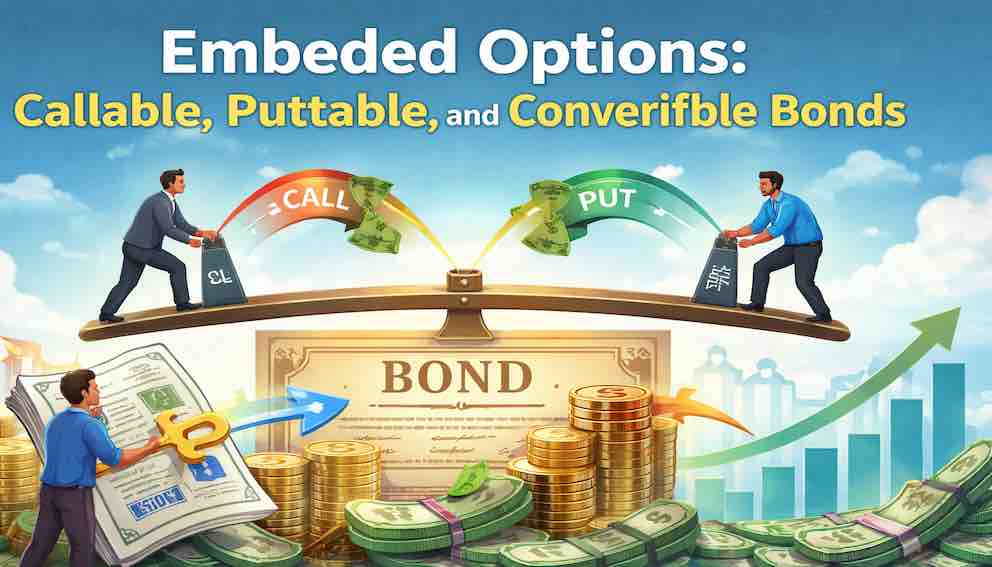
Many bonds carry hidden levers known as embedded options, which can dramatically change their risk and return profile. This tutorial explores callable bonds (where the issuer can repay early), puttable bonds (where investors can demand early repayment), and convertible bonds (which can be exchanged for stock). We explain why these options exist in the market, how they shift control over future cash flows, and the specific risks they create, such as reinvestment risk. Through step-by-step examples, you'll learn how to identify these bonds and decide whether their features justify their yields. By the end, you’ll understand that who holds the option is just as important as the coupon itself.
Introduction: The Fine Print That Changes Everything
Imagine buying a 10-year bond from a company like "SolarGrid Utilities," attracted by its 6% coupon. Two years later, interest rates fall, and you receive a notice: SolarGrid is calling your bond. You get your money back, but now the best available rate is 4%. Your expected income just vanished, even though you had made what seemed like a sound investment.
This isn’t a market malfunction; it’s the fine print at work. Many bonds carry embedded options, hidden clauses that give one party—the issuer or the investor—the right to change the bond’s cash flows in the future. These options exist for rational reasons: issuers want flexibility to reduce borrowing costs, while investors may seek protection against rate rises or credit deterioration. Understanding who holds the control in each scenario is essential to managing risk and making informed investment decisions.
Part 1: Callable Bonds – The Issuer’s “Get Out of Jail Free” Card
A callable bond gives the issuer the right to repay the bond early, typically when it benefits them most—usually when interest rates fall. Think of it as a company’s version of refinancing a mortgage: just as a homeowner might replace a high-interest mortgage with a lower-rate one, a company can “call” expensive debt and replace it with cheaper debt.
Why It Exists & The Investor’s Dilemma
Issuers include call options because it allows them to reduce future interest costs. For investors, however, this creates reinvestment risk—the risk that the principal will be returned when prevailing interest rates are lower, forcing the investor to reinvest at a less favorable yield.
Scenario Example:
- You buy a 10-year callable bond for $1,000 at a 6% coupon.
- After 5 years, market rates drop to 3%.
If the bond is called:
- You receive your $1,000 back.
- You can now only reinvest at 3%, rather than the 6% you had been receiving.
The Yield “Ceiling” in Action
Callable bonds also cap the potential price appreciation, creating a price ceiling. Suppose we compare two bonds from the same company:
- Bond A (Non-Callable): 5.5% coupon, 10-year maturity.
- Bond B (Callable): 6% coupon, 10-year maturity, callable after year 5.
Scenario: Rates drop to 3% in year 6.
- Bond A: Price may rise to around $1,200 as investors compete for higher-than-market payments. You enjoy both the coupon and capital appreciation.
- Bond B: Likely called at $1,000. You miss the rally. Your “higher” 6% coupon was temporary; the upside is capped.
Key Insight: The higher yield on callable bonds is compensation for taking reinvestment risk, not a free lunch. The bond’s life can be cut short, limiting your gains if interest rates fall.
Part 2: Puttable Bonds – Your “Emergency Exit” Door
Puttable bonds shift control to the investor. They give you the right to sell the bond back to the issuer at a predetermined price before maturity. This option acts like an insurance policy against adverse scenarios.
How Put Options Protect You
Two main triggers make the put option valuable:
- Rising Interest Rates: If you hold a 4% bond and new issues pay 7%, your bond’s market price falls. Exercising the put allows you to redeem it at par and reinvest at the higher rate.
- Deteriorating Credit: If the issuer’s financial health declines, you can demand repayment before a potential default, protecting your principal.
Trade-Off: Safety Comes at a Cost
Issuers price this protection by offering lower coupons. You’re effectively buying insurance with foregone interest.
Example Scenario:
- Bond X (Standard): 7% coupon, 10-year maturity.
- Bond Y (Puttable): 6.5% coupon, 10-year maturity, with put option at year 5.
If the tech sector downturns in year 5:
- Bond X may fall to $850, reflecting market risk.
- Bond Y allows you to redeem at $1,000, preserving capital.
The 0.5% lower coupon was the price of your safety net—your insurance premium.
Part 3: Convertible Bonds – “Heads You Win, Tails You Don’t Lose Much”
A convertible bond combines bond-like stability with the option to convert into equity. It allows investors to benefit from equity upside while protecting downside with the bond floor.
Asymmetric Outcomes Explained
- If the stock underperforms: You ignore the conversion option and hold the bond. Collect coupon payments and principal, assuming no default. You avoid equity losses but may earn less than a standard bondholder.
- If the stock soars: Conversion allows you to participate in equity gains. The potential upside can significantly exceed the original bond investment.
Detailed Example:
- Company: BioGrowth Inc.
- Convertible bond: 5-year, $1,000 face value, 3% coupon.
- Conversion: 40 shares per bond.
Outcome A – Stock tanks:
- Stock price remains $15 → 40 shares worth $600.
- You hold bond to maturity, earning 3% coupon → total roughly $1,150 ($1,000 principal + coupons).
- You underperform a standard bond at 5%, but avoid equity loss.
Outcome B – Stock soars:
- Stock jumps to $50 → 40 shares worth $2,000.
- You convert → total return doubles, far above principal and coupon.
Key Insight: The convertible bond is a bond with a built-in stock option. You pay for the option via a lower coupon, but you gain asymmetric exposure: moderate downside risk with potential upside.
Part 4: How to Spot and Evaluate These Bonds (Your Action Plan)
What “yield-to-worst” means instead
Yield-to-worst (YTW) asks a much more defensive and realistic question:
“What is the lowest return I could reasonably earn if the issuer acts in their own best interest?”
For a callable bond, that usually means:
- The bond is called at the earliest possible call date
- It is called at the call price, not at a market premium
- Your high-coupon income stream ends as soon as it becomes inconvenient for the issuer
Yield-to-worst is not pessimistic.
It is simply issuer-aware.
Read the Label
- Callable: “Callable,” “redeemable,” “subject to redemption.” Check call schedule and price.
- Puttable: “Putable,” “holder’s option to redeem.” Note the timing and put price.
- Convertible: “Convertible,” “convertible note,” or “CB.” Look for conversion ratio and price.
Ask the Right Questions
- Callable: “What is the lowest return(yield-to-worst) I could reasonably earn if the issuer acts in their own best interest?” “Is the yield-to-worst attractive, not just yield-to-maturity?”
- Puttable: “Does downside protection justify the lower coupon?”
- Convertible: “At what stock price does conversion break even? Is that realistic before maturity?”
Align With Your Goals
- Stable Income: Be cautious with callable bonds; yield-to-worst may be the best metric.
- Protection Needs: Puttable bonds may provide insurance in volatile sectors.
- Equity Upside: Convertibles allow partial participation with limited bond-like risk.
Conclusion: Control Is the Ultimate Feature
Embedded options transform a bond from a static contract into a dynamic investment where control over the future matters:
- Callable Bonds: Favor the issuer, cap upside, and impose reinvestment risk. Higher coupon compensates for this.
- Puttable Bonds: Favor the investor, providing an exit strategy at a cost of slightly lower income.
- Convertible Bonds: Offer conditional control; investors can switch from creditor to shareholder if conditions are favorable.
Takeaway: Never evaluate a bond by its coupon alone. Ask: Who holds the options, and how will they act if conditions change? Recognizing embedded options allows you to anticipate outcomes, manage risk, and invest strategically rather than reactively.
About Swati Sharma
Lead Editor at MyEyze, Economist & Finance Research WriterSwati Sharma is an economist with a Bachelor’s degree in Economics (Honours), CIPD Level 5 certification, and an MBA, and over 18 years of experience across management consulting, investment, and technology organizations. She specializes in research-driven financial education, focusing on economics, markets, and investor behavior, with a passion for making complex financial concepts clear, accurate, and accessible to a broad audience.
Disclaimer
This article is for educational purposes only and should not be interpreted as financial advice. Readers should consult a qualified financial professional before making investment decisions. Assistance from AI-powered generative tools was taken to format and improve language flow. While we strive for accuracy, this content may contain errors or omissions and should be independently verified.