
Tutorial Categories
Last Updated: February 11, 2026 at 18:30
Active vs Passive Fixed Income: Understanding Costs, Taxes, and What You Really Keep
Deciding between active and passive fixed income investing requires understanding not just potential returns, but also fees, turnover, and taxes that can quietly reduce what you actually keep. This tutorial explores the claims of active managers, the mechanics of bond index construction, and how costs can erode performance over time. We also examine the basics of tax treatment for fixed income, including accrued interest, original issue discount, and municipal bonds. By the end, you will have a clearer mental model: in fixed income investing, what you retain after costs and taxes often matters more than headline yields, helping you make smarter portfolio decisions.
Introduction: The Performance Race With a Hidden Handicap
After learning to build the steady, predictable engine of a bond ladder, we now face a more philosophical question: Who should drive it? Should you hire an expert driver (an active manager) to navigate every twist and turn of the interest rate and credit markets, or simply hitch your wagon to the entire market train (a passive index) and enjoy the ride at a lower cost? This is the active versus passive debate.
In stocks, this debate often centers on the "efficient market hypothesis." But in bonds, the calculus is different. It is less about finding hidden gems and more about avoiding costly mistakes and unnecessary friction. Because bonds are fundamentally lower-returning assets than stocks, every dollar lost to fees, poor trading, or taxes takes a much larger bite out of your real wealth. This tutorial is about learning to spot that hidden handicap before the race even begins.
Part 1: The Real Mechanics – Where Active Management Tries to Add Value
Active bond management is more than picking bonds. A skilled active manager makes three big, ongoing bets:
1. Interest Rate Timing
They adjust the portfolio’s average duration. If rates are expected to rise, they shorten duration to reduce price sensitivity; if rates are expected to fall, they may lengthen duration to capture price gains.
2. Sector Rotation
Active managers shift weight between Treasuries, corporates, mortgage-backed securities (MBS), and emerging market debt based on credit spreads, economic cycles, and relative value.
3. Credit Selection
They aim to identify undervalued bonds within a sector—perhaps a BB-rated company about to be upgraded, or avoiding a BBB-rated company trending toward “fallen angel” status.
The Promise vs. The Reality
The promise is that a smart team can out-think the collective market on these fronts. The harsh reality is that these are essentially zero-sum games before costs. For one manager to outperform, another must underperform. And the costs of playing—the manager’s salary, research team, and trading desk—are all paid by you, the investor, through fees. This creates a very high hurdle just to break even with the market.
Part 2: The Silent Killers – How Costs and Taxes Devour Yield
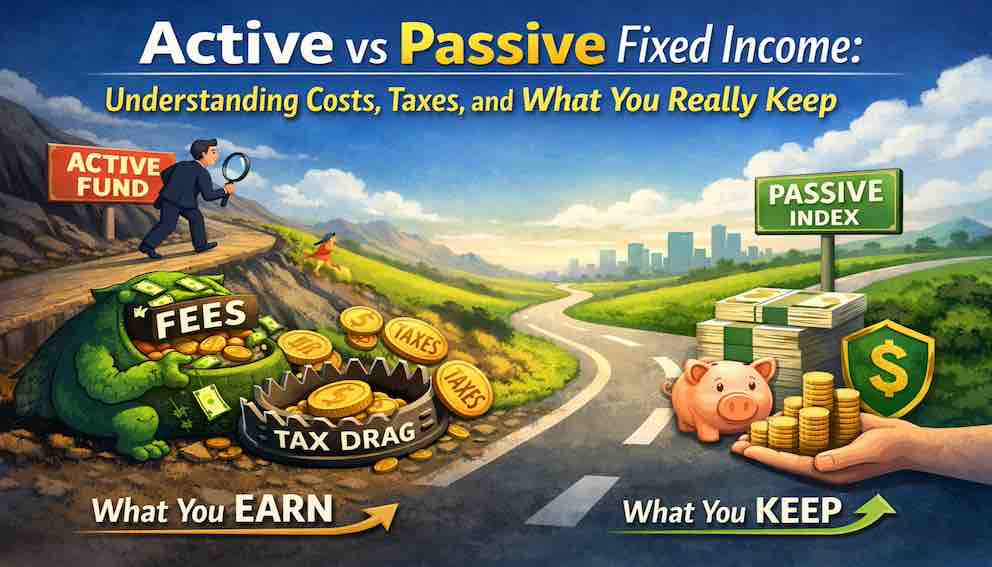
Even modest fees and tax inefficiencies can quietly erode what you keep. Let’s personify them as two silent enemies of your fixed income returns.
Enemy #1: The Fee Monster
Imagine you own a rental property generating $4,000 a year. Now imagine a property manager who charges a percentage of the property value every year, whether it needs managing or not. That is the equivalent of an active fund’s expense ratio.
In bonds, with yields often in the 3–5% range, a 0.75% annual fee is not a trivial deduction; it consumes roughly 15–25% of your annual income. Over decades, this isn’t a small cost—it is a significant wealth transfer.
A Realistic Illustration:
Two investors, each with $100,000 in 2003, both targeting the Bloomberg U.S. Aggregate Bond Index:
- Investor A: Low-cost index ETF, 0.05% fee
- Investor B: Typical active fund, 0.75% fee
By 2023, after two decades of compounding, Investor A would have roughly $50,000 more than Investor B, purely because of the 0.70% fee difference. The active manager would need to consistently outperform just to break even—a rare feat.
Enemy #2: The Tax Drag
Bonds are inherently tax-inefficient. Interest is taxed as ordinary income, often at your highest marginal rate, unlike stock dividends, which may receive preferential treatment. Active management can worsen this through higher portfolio turnover.
Turnover Creates Taxable Events:
- When an active manager sells a bond before maturity, capital gains distributions are triggered.
- Frequent turnover generates multiple taxable events, creating a drag invisible in pre-tax performance.
Accrued Interest Example:
If a bond pays $1,000 annually in two semi-annual payments and you buy halfway through, you pay the seller $500 in accrued interest. That $500 is considered taxable income for the year it accrues, even though it initially went to the seller.
Original Issue Discount (OID) Example:
A bond with a $1,000 face value is issued at $950. The $50 discount accrues over five years. Each year, $10 is counted as taxable interest, even though you won’t receive it in cash until maturity.
Municipal Bonds:
Municipal bonds, issued by state or local governments, are often exempt from federal income tax and sometimes from state taxes if you reside locally. This makes them an efficient choice for taxable accounts, particularly for higher-bracket investors.
Mental Model: In fixed income investing, what you keep after fees and taxes is more important than what you earnbefore them.
Part 3: The Passive Reality – You’re Buying a “Liquid Index,” Not a Perfect Portfolio
Passive bond investing is more nuanced than it appears. Unlike a stock index like the S&P 500, which holds liquid companies, a bond index like the Agg holds thousands of bonds, many illiquid. This creates tracking error—the difference between index returns and fund returns.
Market-cap weighted bond indices also overweight the largest borrowers. For example, the U.S. Treasury dominates the Agg, making passive bond investors heavily exposed to government debt and interest rate policy. Passive does not mean “neutral”; it means accepting the market’s construction as your own.
Connecting to Laddering:
Even within a passive core, you can structure maturities using ladders to align cash flows with your spending needs. Active management, when selectively applied, can complement this by targeting niche markets or risk segments without compromising the stability of the core ladder.
Part 4: A Practical Decision Matrix – When to Consider Each Path
Instead of absolutes, think about strategy alignment with market efficiency, cost, and your goals.
Favor PASSIVE (Low-Cost Index Funds/ETFs) for:
- Core Exposure: U.S. Treasuries or high-grade aggregate bonds, where beating the market is difficult.
- Transparency and Control: You know exactly what you own via the index.
- Taxable Accounts: Low turnover makes index ETFs tax-efficient.
Consider ACTIVE Management for:
- Inefficient Market Niches: High-yield (junk) bonds, emerging markets, complex securitized products.
- Specific, Non-Index Goals: Absolute income, inflation protection, or targeted interest rate risk mitigation.
- Downside Protection in Risky Segments: Avoiding defaults or “fallen angels” in volatile credit markets.
Conclusion: The “Keep-What-You-Earn” Imperative
Active versus passive fixed income investing is less about chasing returns and more about controlling erosion from fees and taxes. The most reliable way to improve your net outcome is to minimize friction between the market’s return and your pocket.
This means:
- Using a low-cost passive core for the majority of your bond holdings
- Employing tax-advantaged accounts for taxable bonds
- Considering active management only in niche markets where expertise can justify the cost
Ultimately, bond investing rewards humility. Accepting the market’s return, minus avoidable fees and taxes, is not a passive surrender; it is an intelligent, active choice to keep what you earn. In a low-yield environment, the true enemy is not modest returns—it is the silent, compounding erosion of wealth from costs you control.
About Swati Sharma
Lead Editor at MyEyze, Economist & Finance Research WriterSwati Sharma is an economist with a Bachelor’s degree in Economics (Honours), CIPD Level 5 certification, and an MBA, and over 18 years of experience across management consulting, investment, and technology organizations. She specializes in research-driven financial education, focusing on economics, markets, and investor behavior, with a passion for making complex financial concepts clear, accurate, and accessible to a broad audience.
Disclaimer
This article is for educational purposes only and should not be interpreted as financial advice. Readers should consult a qualified financial professional before making investment decisions. Assistance from AI-powered generative tools was taken to format and improve language flow. While we strive for accuracy, this content may contain errors or omissions and should be independently verified.