
Tutorial Categories
Last Updated: February 11, 2026 at 18:30
Common Bond Myths and Costly Mistakes: How to Avoid Traps That Undermine Your Fixed Income Returns
Many investors assume bonds are always safe or that higher yields automatically mean higher returns, but these beliefs can lead to costly mistakes. This tutorial explores the most common bond myths, from yield chasing and rising rate fears to callable bond traps. By understanding where equity intuition fails and how fixed income behaves differently, investors can make smarter decisions, avoid hidden risks, and preserve long-term wealth in a bond portfolio.
Introduction: The Siren Songs of the Bond Market
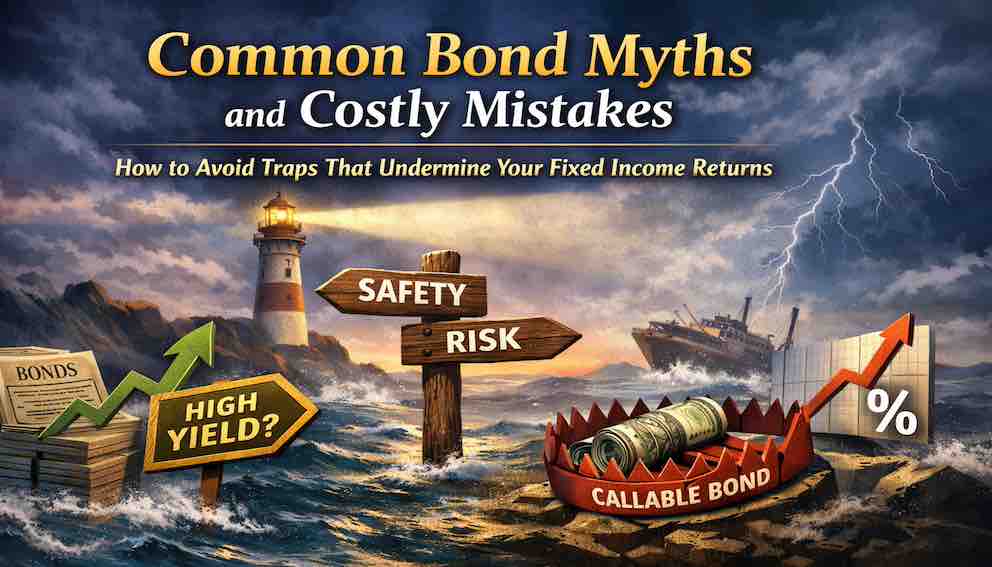
After our journey through the mechanics, strategies, and risks of fixed income, we arrive at a critical destination: the psychology of error. The bond market, with its complex cash flows, invisible risks, and subtle trade-offs, sings several alluring but dangerous siren songs.
These are the myths that sound logical—“higher yield is better,” “bonds are safe”—but which, when followed, can shipwreck an investor’s capital on hidden shoals. Unlike equity mistakes, which often happen because of greed or impatience, bond mistakes occur when our intuition—shaped by equities or oversimplified rules—misapplies to fixed income. This tutorial is your guide to recognizing these siren songs for what they are, and steering a steady course past them by applying the patient logic of bonds.
Myth 1: “Bonds Are Safe” – The Illusion of the Risk-Free Haven
The most seductive and dangerous myth is that bonds are automatically safe. Many investors confuse lower volatility with the absence of risk. Bonds, like any financial instrument, carry multiple risks, and what is “safe” for one investor may be perilous for another.
Breaking Down Bond Risks
Credit Risk (Default):
- Even corporate or municipal bonds can fail to pay interest or principal. Government bonds, such as U.S. Treasuries, are usually safe from default, but they are not immune to other risks.
Interest Rate Risk (Price Volatility):
- When market interest rates rise, existing bond prices fall. For example, a 10-year Treasury paying 3% may lose significant market value if rates rise to 5%. This is a temporary, mark-to-market loss if held to maturity, but it can be devastating for investors needing liquidity.
Inflation Risk (Purchasing Power):
- Fixed interest payments may not keep up with rising prices. A 3% yield in a 5% inflation environment reduces real purchasing power over time.
Liquidity Risk (Ease of Sale):
- Some bonds are thinly traded. Selling in a hurry may force you to accept a lower price than expected.
Individual Bonds vs Bond Funds
- Individual Bond: Holding to maturity generally ensures you receive the promised cash flows.
- Bond Fund: Bonds in a fund are constantly bought and sold. Prices fluctuate permanently, and you never know exactly when you will sell at what price.
Example:
In 2022, long-term U.S. Treasuries lost around 30% of market value due to rising rates. An investor holding a bond fund would have felt a persistent decline in portfolio value, whereas someone holding individual Treasuries to maturity would have still received full principal and interest.
Antidote: Replace vague notions of “safe” with precise questions: Safe from what? Default, interest rate moves, inflation, or liquidity? Choose bonds that match your specific safety needs.
Myth 2: “Higher Yield = Better Investment” – The Glitter of Fool’s Gold
Many investors fall for the allure of high yields, assuming that more income automatically means better returns. This is equity thinking applied to fixed income—a dangerous mismatch.
Why Higher Yield Exists
The extra yield is rarely generosity. It compensates for one or more risks:
- Credit Risk: Higher yield reflects doubt about the issuer’s ability to pay.
- Duration Risk: Longer-term bonds pay more to compensate for interest rate sensitivity.
- Liquidity Risk: Illiquid bonds offer more yield to attract buyers.
- Call Risk: Callable bonds pay more because the issuer may redeem them early.
Example:
Consider two bonds:
- AAA-rated corporate bond: 4% yield
- BB-rated corporate bond: 6.5% yield
The 2.5% difference is not “free money”; it’s the market pricing in a higher probability of default, longer duration risk, and possible call events. Buying the higher-yield bond is effectively underwriting risk in hopes of earning the premium.
Antidote: Never evaluate yield in isolation. Read it as a story: what risks are being priced in, and are you willing and able to bear them?
Myth 3: “Rising Rates Are Bad for Bonds” – The Half-Truth Panic
Investors often panic when rates rise, assuming all bond investments will lose value. This is only partially true.
The Owner’s Perspective
If you hold an individual bond to maturity, temporary price declines are irrelevant—you still receive promised coupon payments and principal at the end.
The Ladder Advantage
For a bond ladder, rising rates are a benefit. As each rung matures, you reinvest at higher rates, gradually improving portfolio income. Panic-selling after rates rise locks in losses and forfeits future opportunities.
Example:
Imagine a laddered portfolio with bonds maturing annually. Year one: bond matures at 3% yield. Year two: rates rise to 4%, so the next reinvestment earns 4%, and so on. Over time, rising rates increase your cash flows.
Antidote: Distinguish between permanent capital loss (default) and temporary price fluctuation (mark-to-market). Let strategy, not headlines, guide your actions.
Myth 4: “I Can Time the Bond Market” – The Active Manager’s Vanity
Trying to predict interest rates and duration changes is a costly endeavor.
Why Market Timing Fails
- The Market is Forward-Looking: Today’s yields already reflect expectations for the future.
- High Cost of Mistakes: Shortening duration to avoid a forecasted rate hike can forfeit income if rates do not rise.
Antidote: Build portfolios around structure, not prediction. Bond ladders, duration matching, and diversification allow you to perform well without needing to forecast rates accurately.
Myth 5: “All Bonds in a Category Are the Same” – The Danger of Labels
Diversification is often misapplied. Owning a corporate bond ETF or municipal bond fund does not guarantee safety.
Example:
- A corporate bond fund may be concentrated in high-debt companies.
- Municipal bonds may vary widely: General Obligation vs revenue bonds for speculative projects.
Antidote: Look under the hood: check credit quality distribution, sector allocation, duration, and covenants. Treat each bond as a distinct investment, not a generic label.
Equity Intuition vs Bond Reality
Most bond mistakes come from applying equity thinking to fixed income. To make this concrete, consider the differences in mindset:
Equity Thinking:
- Seeks growth, upside potential, and compelling stories about companies.
- Comfortable with volatility, seeing short-term price swings as the cost of opportunity.
- Focuses on short-term trends, trying to predict which stocks will outperform.
Bond Thinking:
- Seeks certainty, reliable cash flows, and preservation of capital.
- Views volatility as a threat to predictable outcomes rather than an opportunity.
- Focuses on long-term cash flows, structural portfolio design, and risk alignment rather than trying to forecast market moves.
Example: Chasing a high-yield bond because it looks “exciting” is like chasing a hot stock tip—you are exposing yourself to unexpected risk. Panicking when rates rise is akin to selling a stock after a bad earnings report. Treating bonds as liquid as stocks can also backfire if the market is thin. Recognizing these differences is key to avoiding costly mistakes in fixed-income investing.
Callable Bonds: Hidden Traps
Callable bonds pay higher yields because the issuer may redeem early, especially if rates fall.
Example:
A 10-year callable bond with a 6% coupon is called after 3 years when rates drop to 3%. The investor must reinvest at lower yields, losing expected income.
Antidote: Always check call features, understand reinvestment risk, and consider duration and rate scenarios.
Inflation and Liquidity Considerations
Even “safe” bonds can lose real value due to inflation. Fixed coupons erode purchasing power if inflation exceeds yield. Illiquid bonds can prevent timely exits at fair prices, particularly in stress periods. Consider TIPS, short-term bonds, and liquid markets to mitigate these risks.
The Bond Investor’s Creed
To internalize these lessons, adopt a disciplined mindset:
- Seek Specific Safety: Match bonds to protect against particular risks—TIPS for inflation, short Treasuries for liquidity, ladders for reinvestment.
- Respect Yield as a Risk Signal: High yield is a warning, not a prize. Investigate the risks priced in.
- Be an Owner, Not a Trader: Structure portfolios to hold bonds, focusing on scheduled cash flows rather than daily prices.
- Prefer Structure to Prediction: Use ladders, duration matching, and diversification rather than forecasting the unpredictable.
- Mind the Gap Between Intuition and Reality: Check your reasoning to avoid importing stock-market biases.
By following this creed, you evolve from a passive bond buyer into a thoughtful fixed-income investor, recognizing siren songs and navigating safely through hidden risks.
Conclusion
In this tutorial, we explored the myths and traps that frequently undermine bond investing. Bonds are not risk-free, higher yields are not inherently better, and rising rates do not automatically destroy value. Mistakes often stem from applying equity intuition to fixed income. By understanding risk breakdowns, incorporating laddering, checking credit and liquidity, and respecting yield as a risk signal, investors can build robust, disciplined, and stable bond portfolios. The siren songs of the market lose their power when approached with patience, structure, and informed judgment, allowing bonds to serve their true purpose: predictable, steady, long-term wealth preservation and growth.
About Swati Sharma
Lead Editor at MyEyze, Economist & Finance Research WriterSwati Sharma is an economist with a Bachelor’s degree in Economics (Honours), CIPD Level 5 certification, and an MBA, and over 18 years of experience across management consulting, investment, and technology organizations. She specializes in research-driven financial education, focusing on economics, markets, and investor behavior, with a passion for making complex financial concepts clear, accurate, and accessible to a broad audience.
Disclaimer
This article is for educational purposes only and should not be interpreted as financial advice. Readers should consult a qualified financial professional before making investment decisions. Assistance from AI-powered generative tools was taken to format and improve language flow. While we strive for accuracy, this content may contain errors or omissions and should be independently verified.