
Tutorial Categories
Last Updated: February 4, 2026 at 19:30
The Language of Finance: How to Read Financial Statements and Understand a Business’s True Story - Fundamental Analysis Series
Financial statements are the most reliable window into a business's true operations, moving you beyond headlines and stock prices. This tutorial explains the three core documents—the Income Statement, Balance Sheet, and Cash Flow Statement—in clear, practical terms. You'll learn what each reveals, how they connect, and how to spot the real story they tell together. Through a single, unified example, you'll see how profits, assets, and cash interact. By the end, financial statements will feel less like intimidating spreadsheets and more like a coherent biography of a business you can understand and analyze.
Why Financial Statements Matter: The Facts Behind the Story
If investing is about owning a business, then financial statements are your operations manual. They help an analyst to move from guessing ("The stock is down, is something wrong?") to knowing ("Their inventory is building up faster than sales, which is squeezing their cash").
These documents are not marketing materials. They are standardized records of economic reality. While accounting involves judgment—like how quickly to depreciate equipment or recognize revenue—the framework itself provides a consistent language for comparing companies. Learning this language is the most practical skill in fundamental analysis.
One Business, Three Perspectives: The Core Principle
The most common mistake is treating these as separate reports. They are three interconnected views of one business.
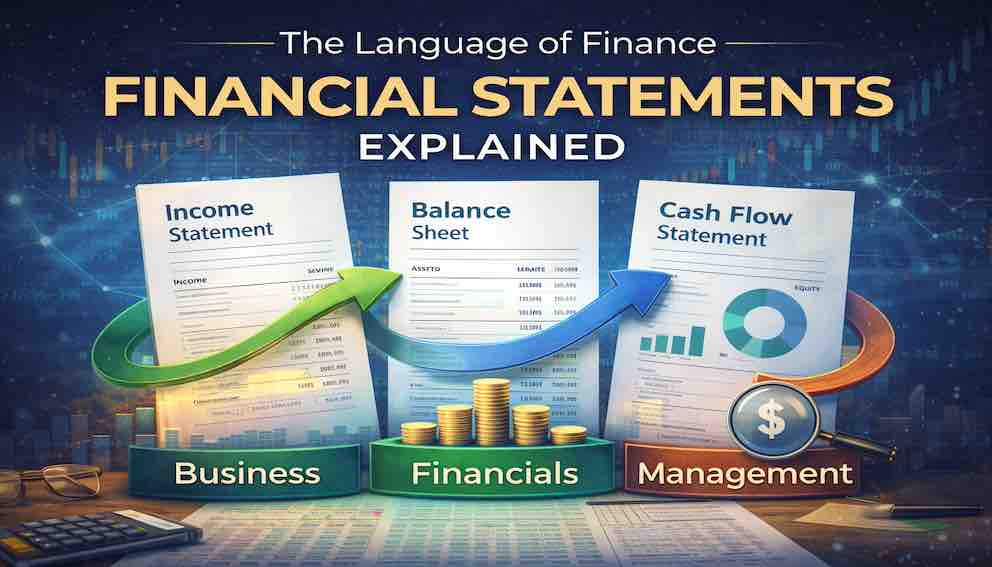
- The Income Statement: The "Movie" of performance over a period (a quarter or year). Did we make money?
- The Balance Sheet: The "Snapshot" of financial health at a point in time. What do we own and owe right now?
- The Cash Flow Statement: The "Bank Statement" reconciling the movie and the snapshot. Where did the cash actually come from and go?
They are mathematically linked. A profit on the income statement should increase equity on the balance sheet, but only if that profit turns into real cash. This connection is your most powerful analytical tool.
A Unified Example: "Maria's Bookshop"
Let's follow one year for a small business to see all three financial statements emerge. This simplification teaches universal principles that apply to companies like Apple or Coca-Cola.
The Business: Maria invests $10,000 of her savings to open a bookshop. She buys $8,000 worth of books (inventory) and a $2,000 cash register. She takes a $5,000 loan for extra working capital.
1. The Income Statement: The Year's Performance
This shows the flow of earnings and expenses.
Revenue: Total sales to customers: $50,000. This is the total value of all books sold during the year, regardless of whether cash was received.
Cost of Goods Sold (COGS): The cost of the books she sold: $30,000. This is the wholesale price Maria paid for the specific books that left her shelves and went to customers.
Gross Profit: Revenue - COGS = $20,000. This is her initial profit from selling books, before covering the costs of running the shop itself.
Operating Expenses: Rent, utilities, salary, marketing: $15,000. These are the ongoing costs required to operate the business day-to-day.
Operating Income: Gross Profit - Operating Expenses = $5,000. This profit measures the success of her core business operations.
Interest Expense: Cost of the bank loan: $300. This is the fee for using the bank's money.
Net Income (The "Bottom Line"): Operating Income - Interest = $4,700. This is the accounting profit for the year. It is a calculation of earnings, not a measure of cash collected.
Key Insight: The Income Statement says Maria was profitable. But did all $4,700 end up as cash in her register? Not necessarily. This is a critical distinction because the Income Statement records revenue when a sale is made (like selling to a school on credit), not when cash is received. Profit is an accounting concept; cash is a tangible reality.
2. The Balance Sheet: The Year-End Snapshot
This is a static picture of her finances on December 31st. It follows the fundamental accounting equation: Assets = Liabilities + Equity.
ASSETS (What she OWNS & CONTROLS)
- Cash: $6,400 in the register and bank. This is the actual, spendable money.
- Accounts Receivable: $3,400. These are books sold to the school on credit. She owns the right to collect this money, but it is not yet cash.
- Inventory: $6,000 worth of unsold books. This is an asset waiting to be converted into sales (and eventually cash).
- Equipment: The cash register, now valued at $1,800. The original $2,000 cost is reduced by $200 for depreciation, reflecting its use during the year.
- TOTAL ASSETS: $17,600
LIABILITIES & EQUITY (How it's FUNDED)
Liabilities (What she OWES):
- Bank Loan: $4,700. She paid down $300 of the original $5,000, so this is the remaining principal owed.
- Accounts Payable: $1,000. These are books received from a supplier but not yet paid for.
Equity (Her Owner's Stake):
- Contributed Capital: Her original investment of $10,000.
- Retained Earnings: This year's profit of $4,700, which is added to her stake in the business.
- Total Equity: $14,700
TOTAL LIABILITIES + EQUITY: $17,600
Key Insight: The balance sheet reveals financial structure and risk. Maria is using debt (liabilities), which creates a repayment obligation. A portion of her assets ($3,400 in Receivables and $6,000 in Inventory) is not yet cash, highlighting that not all assets are equally liquid. Critically, her equity grew by exactly her annual profit ($4,700), directly linking the Income Statement to the Balance Sheet.
3. The Cash Flow Statement: Tracing the Real Money
Profit on the Income Statement does not always equal cash. Maria earned $4,700, but her year-end cash is $6,400. The Cash Flow Statement reconciles this by showing how cash actually moved, categorizing every dollar into Operations, Investing, or Financing. To build it, we must first find our true starting point.
Step 1: Find the Beginning Cash
The initial purchases happen before Day 1 of the fiscal year. Maria put in $10,000 and borrowed $5,000, bringing in $15,000 cash. She immediately spent $8,000 on inventory and $2,000 on the register, a $10,000 cash outflow. Therefore, on the first day of the business year, her cash balance was not zero—it was $5,000 ($15,000 - $10,000). This is our crucial starting number.
Step 2: Cash generated from Operating Activities
We start with Net Income and adjust for non-cash items and changes in working capital (current assets and liabilities).
- Start with Net Income: $4,700. This is our profit figure from the Income Statement.
- Add Back Depreciation: +$200. Depreciation reduced profit but did not use cash. We add it back.
- Adjust for Increase in Accounts Receivable: -$3,400. This represents sales included in revenue but not yet collected in cash. It's a use of working capital.
- Adjust for Change in Inventory: +$2,000. Inventory decreased from $8,000 to $6,000. Selling old stock means we did not spend new cash to replace those books; this frees up cash.
- Adjust for Increase in Accounts Payable: +$1,000. This is an expense recorded but not yet paid. Delaying payment preserves cash.
Net Cash from Operations: $4,700 + $200 - $3,400 + $2,000 + $1,000 = $4,500. This is the cash generated from the shop's core activities.
Explanation: Why is this $200 less than the $4,700 Net Income? The $200 difference is the net result of converting accounting profit into real cash. The major deduction was the $3,400 in uncollected receivables. However, this cash outflow was partially offset by three inflows: the non-cash depreciation ($200), the cash preserved by selling existing inventory ($2,000), and the cash preserved by delaying payables ($1,000). The combined effect of these adjustments (+$3,200) minus the receivables adjustment (-$3,400) explains the final $200 difference.
Step 3: Cash from Investing Activities
This section covers cash spent on long-term assets. The $2,000 cash register was bought before the year started. During this fiscal year, Maria made no purchases of long-term assets.
Net Cash Used in Investing Activities: $0.
Step 4: Cash from Financing Activities
This covers cash from owners and lenders.
- The $5,000 loan proceeds were received before the year started.
- During the year, she repaid $300 of the loan principal. This is a cash outflow.
- Owner’s draw (Maria withdrew cash for personal use): -$2,800
Net Cash Used in Financing Activities: -$300 (loan repayment) - $2,800 (owner's draw) = -$3,100.
Step 5: The Complete Reconciliation
Beginning Cash Balance: $5,000
- Plus: Cash from Operations: +$4,500
- Plus: Cash from Investing: +$0
- Plus: Cash from Financing: -$3,100
Net Increase in Cash: +$1,400
Ending Cash Balance: $5,000 + $1,400 = $6,400
The Ending Cash of $6,400 matches the Cash on the Balance Sheet exactly. The statements are now perfectly reconciled.
Key Lessons
- Profit is not cash. Net Income is an accrual accounting measure. The Cash Flow Statement shows the real money.
- The three statements are a locked system. The Net Income from the Income Statement flows into Retained Earnings on the Balance Sheet. The Cash Flow Statement explains the change in the Cash account on the Balance Sheet.
- Working capital is a cash engine. Managing inventory, receivables, and payables directly determines how much profit converts into spendable cash. Individual changes can pull cash flow in different directions, and their net effect explains the difference between profit and cash.
- Every transaction fits. Audited financial statements are airtight. Understanding these relationships is the cornerstone of analyzing any business's true financial health.
Bridging to a Public Company: The Framework is Universal
The framework for Apple or Tesla is identical to Maria’s Bookshop, just on a different scale.
- Apple's Income Statement: Revenue (iPhone, Services), minus COGS (parts, manufacturing), minus Operating Expenses (R&D, marketing) = Massive Net Income.
- Apple's Balance Sheet: Huge Cash assets, Inventory, Property (stores, data centers), Debt.
- Apple's Cash Flow Statement: Shows how its profits convert into even more cash, funding dividends, share buybacks, and new technology (Investing).
Critical Context: Industry Matters
While the statement structure is universal, interpretation varies by sector. A software company's main asset isn't inventory but engineers and code. A bank's balance sheet is mostly loans (assets) and deposits (liabilities)—a completely different analysis. We started with simple, tangible businesses like consumer goods or retail to learn the core logic.
The Analyst's Toolkit: What to Look For
When you look at real statements, don't just read the numbers—ask what they imply about the business's story. Connect the dots.
1. Quality of Earnings Check:
- Compare Net Income (Income Statement) to Cash from Operations (Cash Flow Statement).
- What to look for: They should generally move in the same direction over time. If net income is consistently higher than operating cash flow, it's a red flag. The company may be counting sales that aren't converting to cash (like Maria's school sale). Ask: "Are the profits real or just on paper?"
2. Financial Health & Risk Check:
- Examine the Balance Sheet's Liabilities vs. Equity.
- What to look for: Is debt growing faster than equity? A rising debt-to-equity ratio means the business is becoming more leveraged and riskier. Also, check if current assets (like cash and receivables) comfortably exceed current liabilities (bills due within a year). This is a basic test of short-term survival.
3. Sustainability & Strategy Check:
- Analyze the Cash Flow Statement's three sections together.
- What to look for:
- Operations: Is this number positive and growing? It should fund the business.
- Investing: Is this number negative? (It usually should be—companies invest in their future). Can operations fund these investments, or are they relying on debt or stock sales (Financing)?
- Financing: Is the company consistently borrowing or selling stock to stay afloat? Or is it returning excess cash to owners?
Your First Real Analysis: A Practical Exercise
Pick a "Simple" Company: Choose a business with a tangible product and straightforward model. Coca-Cola (KO) or McDonald's (MCD) are perfect. Avoid banks, insurance, or complex tech firms for your first attempt.
Find the Annual Report (10-K): Go to the company's website, Investor Relations section, and look for the most recent "Annual Report" or "Form 10-K."
Skim with Purpose (10 Minutes):
- Income Statement: Find Revenue (Top Line) and Net Income (Bottom Line). Track them for 3 years. Are they growing? Stable? Shrinking?
- Balance Sheet: Find Total Assets, Total Liabilities, and Total Equity. Is equity positive? Calculate the change from last year.
- Cash Flow Statement: Find Net Cash Provided by Operating Activities. Is it positive? Compare it to Net Income for the same year. Are they close?
Ask One Connective Question: "Did the company generate enough cash from operations to cover its investing activities (like new stores or equipment)?" This tells you if it's self-funding.
Conclusion: You Now Speak the Language
Financial statements are the structured story of a business's economic life. You've learned that:
- The Income Statement shows the performance—the result of decisions.
- The Balance Sheet shows the position—the accumulated consequence of all past decisions.
- The Cash Flow Statement shows the reality—the hard truth of cash movement.
True analytical power comes from reading them as one interconnected story. A profitable company that is bleeding cash is telling a story of strain. A modestly profitable company that generates growing, high-quality cash is telling a story of strength and discipline.
A Note for the Learner: Gaining these insights is both a science and an art. The frameworks and ratios give you the rules, but interpreting the nuances—the trends, the quality of cash, the hidden risks—comes with experience, repeated practice, and a careful eye for patterns across multiple companies and years. Don’t worry if it feels challenging at first; every financial statement you study adds to your intuition and analytical skill.
You now have the framework to listen to that story. In the next tutorial, we'll use this language to start asking sharper, more quantitative questions about profitability, financial health, and the vital signs that separate great businesses from fragile ones.
💡 Reflection: Look at your personal finances. Can you construct a simple income statement (Income − Expenses = Savings) and balance sheet (Savings + Car Value − Credit Card Debt = Net Worth)? This personal connection makes corporate statements feel familiar, not foreign.
About Swati Sharma
Lead Editor at MyEyze, Economist & Finance Research WriterSwati Sharma is an economist with a Bachelor’s degree in Economics (Honours), CIPD Level 5 certification, and an MBA, and over 18 years of experience across management consulting, investment, and technology organizations. She specializes in research-driven financial education, focusing on economics, markets, and investor behavior, with a passion for making complex financial concepts clear, accurate, and accessible to a broad audience.
Disclaimer
This article is for educational purposes only and should not be interpreted as financial advice. Readers should consult a qualified financial professional before making investment decisions. Assistance from AI-powered generative tools was taken to format and improve language flow. While we strive for accuracy, this content may contain errors or omissions and should be independently verified.