Tutorial Categories
Last Updated: February 5, 2026 at 10:30
Cash Is King: Mastering Cash Flow Analysis and Assessing the Quality of Earnings - Fundamental Analysis
This tutorial explores why cash is the ultimate test of a business’s health and durability. We break down the three types of cash flow—Operating, Investing, and Financing—and introduce Free Cash Flow as the central measure of a company’s ability to thrive. Through practical examples and intuitive mental models, you'll learn to assess the quality of earnings and see how accounting can distort reported profits. By connecting cash flow to everything you’ve learned, you’ll be able to identify the resilient, cash-generating businesses that are built to compound value for decades.
Introduction: The Profound Difference Between Profit and Cash
Imagine you run a successful consulting firm. You sign a big $100,000 contract in January and immediately record it as revenue. Your income statement for the first quarter looks fantastic. But your client’s payment terms are 90 days. In March, you still haven't seen a dime, yet you must pay your employees, your rent, and your software subscriptions. Your profit is a fiction on paper; your cash reality is a crisis.
This is the core lesson of cash flow analysis. Our previous tutorials taught us to measure efficiency (margins) and capital productivity (ROIC). But those metrics are built on accounting profit, which follows rules that can differ from reality. Cash is the undeniable truth. It is the oxygen of a business. A company can be “profitable” yet suffocate from a lack of cash. Cash flow analysis moves us from judging a business by the story it tells to measuring it by the lifeblood it generates.
The Cash Flow Statement: Your Guide to the Three Rivers of Money
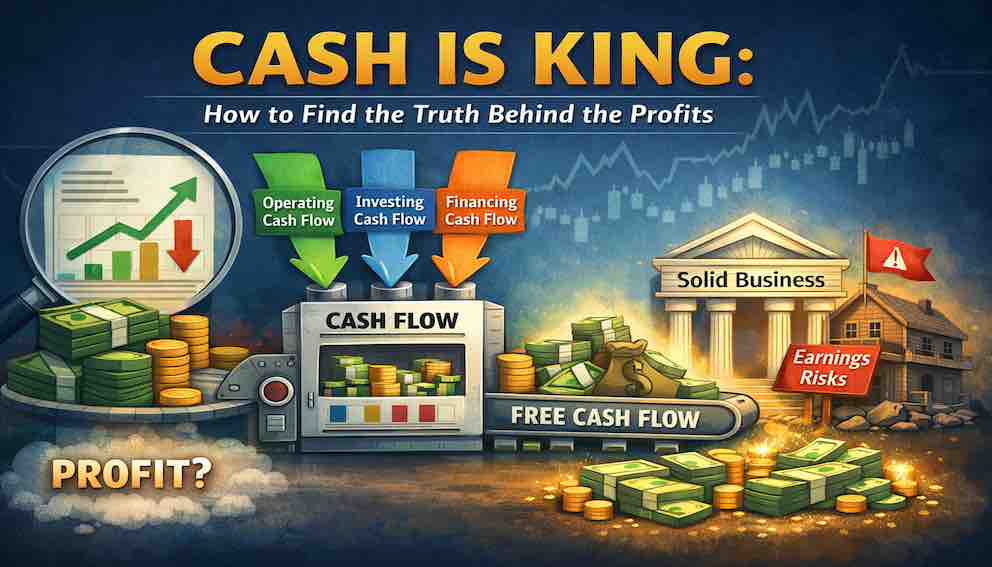
The Cash Flow Statement isn't a single number. It's a map of how money moves through a company, divided into three distinct channels. Think of a household:
- Operating Cash Flow: Your salary and daily living expenses.
- Investing Cash Flow: Buying or selling a car or a house.
- Financing Cash Flow: Taking out a mortgage, getting a student loan, or paying off a credit card.
For a business, these three flows tell the complete story of its economic life.
1. Operating Cash Flow: The Lifeblood of the Business
This is the single most important number on the statement. It answers: Did the company’s core business activities generate cash this period?
It starts with Net Income (the accounting profit) and makes crucial adjustments:
- Adds back non-cash expenses like Depreciation (the theoretical wear-and-tear on a machine).
- Adjusts for changes in Working Capital (the short-term assets and liabilities needed to run the business).
Working Capital is the Key: This is where profit and cash often diverge.
- If a company’s Accounts Receivable (money owed by customers) grows faster than revenue, it means they are selling more on credit. Profit is up, but cash is down.
- If Inventory balloons, cash is tied up in unsold goods.
- If Accounts Payable (money owed to suppliers) increases, the company is delaying payments, which conserves cash in the short term.
Watch the Trend, Not Just One Year: Changes in working capital can cause temporary cash flow swings. A retailer might build inventory before the holidays, hurting cash flow in Q3 but generating a surge in Q4. This is why you must look at trends over several years to see the true, underlying cash-generating power of the business.
The Simple Test: Over time, Operating Cash Flow should trend in the same direction as Net Income, and ideally be larger (because you add back depreciation). A persistent gap where profits exceed cash is a major red flag.
2. Investing Cash Flow: Building for Tomorrow
This section shows how a company invests in its future. It’s typically a negative number (a cash outflow), which is normal and healthy for a growing company.
- Negative Investing Cash Flow = The company is buying property, building factories, upgrading technology, or acquiring other businesses. It’s investing in its long-term capacity.
- Positive Investing Cash Flow = The company is selling off its assets (factories, divisions, investments). This can be a one-time event or a sign of distress.
The Critical Distinction: Maintenance vs. Growth.
Not all investment is equal. A factory must spend money just to repair and replace worn-out equipment—this is maintenance capital expenditure (capex), the cost of standing still. Spending to build a new factory is growth capex. A business with low maintenance capex (like a software company) has a huge advantage over one with high maintenance capex (like an airline)—more of its cash is “free.”
Capital Intensity Defines Destiny: This is a fundamental business model truth. Capital-light businesses (software, SaaS, toll bridges) require little ongoing investment to grow, allowing most profits to convert directly to cash. Capital-intensive businesses (manufacturing, airlines, telecoms) must constantly reinvest huge sums just to maintain their position, trapping cash in physical assets.
3. Financing Cash Flow: The Owner’s Ledger
This shows the transactions between the company and its financiers (owners and lenders).
- Cash Inflows: Issuing new stock or taking on new debt.
- Cash Outflows: Paying dividends, buying back stock, or repaying debt.
The Story it Tells: A mature, cash-rich company will show consistent outflows here (paying dividends, buying back shares). A young, high-growth company will often show inflows (raising money from investors to fund its expansion). Watch for a company that is constantly raising new money (financing inflow) to cover operating losses—this is unsustainable.
Free Cash Flow: The Holy Grail of Investing
Now we combine the two most important sections to find the gold.
Free Cash Flow (FCF) = Operating Cash Flow - Capital Expenditures
This is the cash left over after the company funds its core operations and makes the necessary investments to maintain (or grow) its business. It is the true discretionary cash management can use to:
- Reinvest for organic growth
- Make acquisitions
- Pay down debt
- Pay dividends
- Buy back shares
Why FCF Beats Net Income Every Time
Net Income is an opinion, shaped by accounting rules. Free Cash Flow is a fact. It is much harder to manipulate. A company can’t pay its employees, its suppliers, or its dividends with “earnings.” It pays with cash. FCF tells you if the business is actually generating the fuel it needs to survive and thrive on its own.
The Ultimate Validation: Connecting FCF to ROIC
In our last tutorial, we learned that Return on Invested Capital (ROIC) measures how efficiently a company uses its capital to generate profits. Free Cash Flow is the ultimate validation of that efficiency.
- ROIC tells you the rate of return on capital.
- FCF tells you the cash output from that capital.
A company with a high ROIC but low or negative FCF is a paradox. It suggests the "profits" may be accounting illusions, or that the business requires such heavy, continuous reinvestment that little cash is ever truly "free." Conversely, a company with a high and stable ROIC paired with strong, growing FCF is the ideal: it’s both efficient and generates abundant cash, confirming it’s a true compounding machine.
Earnings Quality: Becoming a Financial Detective
This is where you separate financial substance from illusion. “Earnings Quality” refers to how closely reported profits reflect economic reality and sustainable cash generation. Low-quality earnings are a warning; high-quality earnings are a sign of strength.
The Primary Diagnostic: The Cash Conversion Check
Compare the trend of Net Income to Operating Cash Flow over 5-10 years. They should move together. If Net Income is on a steady climb but Operating Cash Flow is flat or declining, it’s a classic sign of deteriorating earnings quality. The company is booking profits that aren’t turning into cash.
Accounting Tricks to Watch For:
While accounting is necessary, certain aggressive practices can distort reality:
- Early Revenue Recognition: Booking sales before a product is delivered or a service is fully performed (like our consulting firm example).
- Aggressive Accruals: Making optimistic estimates for future warranty costs, bad debts, or restructuring charges to smooth out earnings.
- The "One-Time" Habit: Frequently labeling ordinary expenses as "one-time" or "non-recurring" to make core profits look better.
Common Red Flags in the Cash Flow Statement:
- Consistently Negative Operating Cash Flow: The core business is burning cash. This is only acceptable for a very early-stage company with a clear path to profitability.
- “Peak” Earnings, Trough Cash: Profits are high, but cash flow is weak because money is stuck in receivables and inventory. This often precedes a downturn.
- Financing as a Lifeline: The company is covering negative Operating Cash Flow by constantly issuing new stock or debt (positive Financing Cash Flow). This is borrowing from the future to pay for today.
Case Study: The Tale of Two Retailers
Let’s apply everything to two fictional companies.
FlashTrend Retail (The "Growth" Story)
Income Statement: Revenue and Net Income soar 20% annually. Margins look good.
Cash Flow Statement:
- Operating Cash Flow: Flat. Why? Inventory is ballooning in warehouses, and they’ve extended generous credit to customers to boost sales.
- Investing Cash Flow: Deeply negative. They’re building new stores frantically.
- Financing Cash Flow: Positive. They’re taking on debt to fund the store expansion and cover the cash shortfall from operations.
- Free Cash Flow: Negative. The business is not self-funding. Its “growth” is consuming cash, not creating it.
- The Reality: This is a fragile, capital-intensive model. If sales slow, they’ll be stuck with debt, empty stores, and piles of unsold inventory.
SteadyGoods Merchants (The "Boring" Compounders)
Income Statement: Steady 5% revenue growth, reliable profits.
Cash Flow Statement:
- Operating Cash Flow: Strong, growing, and consistently higher than Net Income (efficient working capital management).
- Investing Cash Flow: Moderately negative (efficient, necessary maintenance and occasional new stores).
- Financing Cash Flow: Negative. They use excess cash to pay a growing dividend and buy back shares.
- Free Cash Flow: Strongly Positive and Growing. The business generates more cash than it needs.
- Capital Allocation in Action: SteadyGoods uses its FCF wisely. Some is reinvested in renovating high-performing stores (high-ROIC projects). The rest is returned to owners via dividends and buybacks, directly rewarding their patience. This is the engine of long-term compounding.
- The Reality: This is a cash machine. It can fund its own growth, reward owners, and withstand economic storms.
Connecting the Dots: The Complete Picture of a Quality Business
Now we unite all our tutorials. A supreme business exhibits:
- Financial Health: A strong balance sheet (low debt, good liquidity).
- Operational Efficiency: High and stable margins, and a high ROIC.
- Cash Generation: Strong, growing Operating Cash Flow and robust Free Cash Flow that validates the high ROIC.
- Capital Allocation Genius: Management uses that FCF wisely—reinvesting at high returns or returning it to shareholders.
When you find a company that checks these boxes, you’ve found a potential compounding machine. The cash flow statement is your proof that the engine is real, not just a clever accounting schematic.
Your Action Plan: How to Analyze Cash Flow Today
Pick a company you’re interested in and pull its last 5-10 years of cash flow statements.
Draw the Trend Lines: On a piece of paper, sketch the long-term trend for:
- Net Income
- Operating Cash Flow
- Capital Expenditures (from Investing Cash Flow)
- Free Cash Flow (simply: OCF minus Capex)
Ask the Diagnostic Questions:
- Is Operating Cash Flow growing and consistently positive?
- Is it generally as large or larger than Net Income? (If not, dig into working capital changes).
- Is Free Cash Flow positive and growing? (Note: treat years with large, one-off acquisitions or asset sales as special cases).
- Looking at Financing Cash Flow: Is the company raising money or returning it? What does that say about its life stage?
Tell the Story: Based on these trends, what narrative do the cash flows support? Is this a cash-gushing fortress or a cash-burning venture?
Conclusion: Cash Doesn't Lie
We’ve journeyed from the philosophy of ownership, through the language of financial statements, to the pillars of health and efficiency, and now to the ultimate reality check: cash.
The cash flow statement transforms investing from a game of expectations into a discipline of verification. Profits are the promise; cash is the proof. Free Cash Flow is the final, unmanipulatable measure of a business's ability to sustain itself, grow, and enrich its owners.
Mastering this analysis gives you a profound advantage. You will no longer be fooled by glamorous growth stories built on accounting smoke and debt mirrors. You will be able to identify the quiet, resilient, cash-compounding machines that are the bedrock of lasting wealth. In a world of noise and narrative, you will have learned to listen for the most reliable sound of all: the steady hum of cash flowing into a business.
Think Like an Owner: Look at a subscription you pay (Netflix, Spotify). That company collects cash from you before it delivers the service—a phenomenal cash flow model. Now think of a custom furniture maker who buys materials, builds for weeks, and only gets paid upon delivery. Which business would you rather own through an economic downturn? This everyday observation is the heart of cash flow analysis.
About Swati Sharma
Lead Editor at MyEyze, Economist & Finance Research WriterSwati Sharma is an economist with a Bachelor’s degree in Economics (Honours), CIPD Level 5 certification, and an MBA, and over 18 years of experience across management consulting, investment, and technology organizations. She specializes in research-driven financial education, focusing on economics, markets, and investor behavior, with a passion for making complex financial concepts clear, accurate, and accessible to a broad audience.
Disclaimer
This article is for educational purposes only and should not be interpreted as financial advice. Readers should consult a qualified financial professional before making investment decisions. Assistance from AI-powered generative tools was taken to format and improve language flow. While we strive for accuracy, this content may contain errors or omissions and should be independently verified.