Tutorial Categories
Last Updated: February 2, 2026 at 10:30
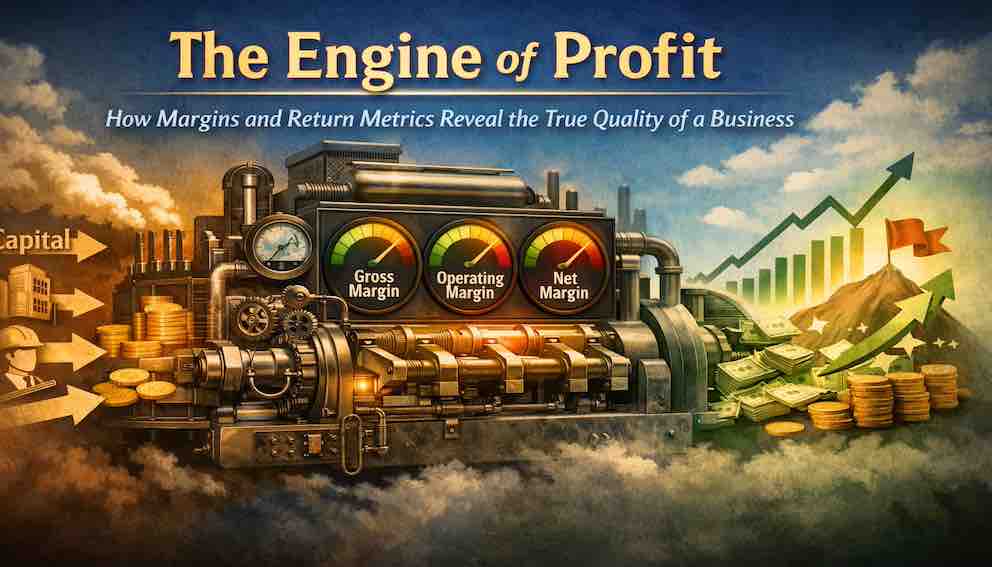
The Engine of Profit: How Margins and Return Metrics Reveal the True Quality of a Business - Fundamental Analysis Series
This tutorial explores how businesses transform revenue and capital into real economic value, showing why efficiency matters more than raw profit size. We unpack profit margins and return metrics as tools for understanding the quality and discipline of a business model, not as abstract ratios to memorize. Through intuitive examples, you’ll learn why Return on Invested Capital (ROIC) is the ultimate test of long-term value creation. The goal is clarity, not precision—to see how well a business rewards the capital entrusted to it. By the end, you’ll understand why two equally "profitable" companies can represent vastly different economic realities for an owner.
From Survival to Performance: The Next Logical Question
Our last tutorial established the first rule: a business must be financially healthy to survive. It must pay its bills and manage its debts. Once we’re reasonably sure it can stay alive, we ask the more profound question: Is it worth keeping alive?
Profitability and return metrics answer this. They move us from analyzing survival to evaluating performance. They tell us not just if a business makes money, but how well it uses every dollar of revenue and every dollar of capital to create value for its owners.
Profit as a Process: The Layered Story of Margins
Profit isn’t a single number at the bottom of a statement. It’s the result of a multi-stage process. Margins let us slow down and examine each stage, revealing where value is created or lost.
Imagine a local bakery.
It brings in money from selling bread (Revenue). The cost of the flour, yeast, and oven power to make that bread is the Cost of Goods Sold (COGS). What’s left is the Gross Profit.
- Gross Margin = Gross Profit / Revenue
- What it tells you: This is the fundamental economics of the product itself. A high gross margin means the bakery has pricing power (its bread is special) or production efficiency (it doesn’t waste flour). It’s the first sign of a potential advantage.
But the bakery isn’t done. It must pay the baker’s salary, the shop’s rent, and the electric bill for the lights. These are operating expenses.
- Operating Margin = Operating Profit / Revenue
- What it tells you: This shows discipline in running the business. After covering the direct costs of the goods, how much is left to manage the operation? A high operating margin suggests a lean, scalable model.
Finally, the bakery accounts for interest on a loan it took for a new oven and its taxes.
- Net Margin = Net Income / Revenue
- What it tells you: This is the final take—what ultimately belongs to the owners. Be careful here: net margin can be boosted by financial engineering (like debt) or one-time events. It’s a useful summary, but never the starting point.
The Margin Story: A company with strong and stable gross and operating margins is usually a well-run business with real pricing power and cost discipline.
By contrast, a company showing a high net margin but a weak operating margin may be benefiting from leverage, tax quirks, or accounting noise rather than business strength—this is often a red flag that deserves deeper scrutiny.
In normal operations:
Gross Margin ≥ Operating Margin ≥ Net Margin
Because each layer subtracts more costs, margins should step down, not up.
So if you ever see Net Profit Margin (NPM) higher than Operating Margin or Gross Margin, something non-operational is happening. It’s not magic — it’s accounting structure. The business didn’t suddenly get better — it just made money outside its core operations.
The Critical Insight: Why High Margins Are Not Enough
This is where many investors stumble. They see high margins and assume they've found a great business. But margins only tell half the story. They show profit per dollar of sale. They ignore a crucial question: How much capital was required to generate that sale?
Consider two very different businesses:
- A Luxury Hotel: It might have very high margins. Guests pay premium prices for rooms and services. But think of the capital required: the land, the building, the lavish furnishings, the constant renovations. It's a capital-intensive business.
- A Grocery Store: It has notoriously thin margins—often just 1-2% net margin. But it turns over its entire inventory in days. The capital invested in that inventory flies back out as cash almost immediately, ready to be reinvested. It's a business built on capital velocity.
This is the fundamental distinction. A great business needs either high margins or fast capital turnover. Truly exceptional businesses often have both. But a business with high margins that is also capital-intensive can be a mediocre investment, while a business with thin margins but lightning-fast turnover can be a compounding machine. This leads us directly to return metrics, which combine both sides of the equation.
Returns: Measuring the Productivity of Capital
Margins tell us how much profit a business earns per dollar of sales.
Return metrics answer a different, deeper question:
For every dollar of capital tied up in this business, how much profit does it produce?
This shift—from sales to capital—is where business quality is truly revealed.
Return on Assets (ROA): Are the Assets Working Hard?
The Question:
How much profit does the company generate from everything it owns?
Formula:
ROA = Net Income / Total Assets
Assets include factories, equipment, inventory, stores, and cash—everything the business needs to operate.
Simple Example:
Imagine two trucking companies, each earning $10 million in profit.
- Company A owns $100 million worth of trucks → ROA = 10%
- Company B owns $200 million worth of trucks → ROA = 5%
Both earn the same profit, but Company A’s assets are working twice as hard.
What it tells you:
ROA is most useful when comparing companies in the same asset-heavy industry. A low ROA often signals idle assets, poor utilization, or excessive investment for the returns being generated.
Return on Equity (ROE): The Popular but Dangerous Measure
The Question: How well are the owners’ funds being rewarded?
The Formula: ROE = Net Income / Shareholders’ Equity
Why it’s appealing: ROE speaks directly to shareholders. A higher ROE suggests management is generating more profit from each dollar of owner capital.
The Core Problem: ROE can be artificially inflated by taking on more debt, which increases financial risk without necessarily improving operational performance.
Example:
Imagine two companies, each with $100 million in assets generating $10 million in net income.
- Company A (No Debt):
- Assets: $100M | Debt: $0 | Equity: $100M
- ROE = $10M / $100M = 10%
- Company B (Uses Debt):
- Assets: $100M | Debt: $60M | Equity: $40M
- ROE = $10M / $40M = 25%
The Illusion: Company B's ROE (25%) appears 2.5x better than Company A's (10%).
The Reality: Both companies are equally profitable operationally (earning $10M from $100M in assets). Company B's higher ROE is solely a mathematical result of using more debt, which magnifies returns for shareholders but also significantly increases the risk of financial distress.
Key Rule: A high ROE is meaningless without checking the debt level. A company with surging ROE and soaring debt hasn't necessarily become a better business—it has likely become a riskier one.
Return on Invested Capital (ROIC): The Gold Standard
The Question That Actually Matters:
Regardless of where the money came from—owners or lenders—how well does the core business turn capital into profit?
Simplified Formula:
ROIC ≈ Operating Profit / Invested Capital
Where:
- Operating Profit reflects the business before financing choices
- Invested Capital includes equity + debt used in operations
Why ROIC is superior:
It removes financing tricks and focuses on business economics.
ROIC is the bridge between:
- Margins (profit per dollar of sales), and
- Capital Turnover (sales per dollar of capital)
A business can earn a high ROIC in two ways:
- High margins (e.g., software with low capital needs)
- Fast capital turnover (e.g., retail selling inventory quickly)
The best businesses combine both.
Simple Contrast:
- A software firm earning $30 on every $100 of capital → ROIC = 30%
- A retailer earning $8 on every $40 of capital → ROIC = 20%
Different models. Same insight: capital productivity.
The Owner’s Lens
- ROA asks: Are the assets efficient?
- ROE asks: How does leverage affect owners?
- ROIC asks: Is this business model genuinely good at compounding capital?
- That’s why long-term owners focus on ROIC over time. It’s the clearest signal of a business that can grow without consuming ever more capital.
The Reinvestment Gravity: The Hidden Drag on Returns
Understanding ROIC requires a final, critical layer: the reinvestment burden. Businesses are not static. Equipment wears out, stores need refurbishing, software becomes obsolete. This is maintenance reinvestment—the capital required just to keep the business running at its current level.
Some businesses, like railroads or semiconductor foundries, have a crushing reinvestment burden. They must spend huge sums continually just to stand still, which acts as a constant gravitational pull dragging down their returns. Others, like certain branded software or consumer goods companies, have very light maintenance needs. Their profits are far more "free" to be returned to owners or invested in new growth.
When you see a high ROIC, always ask: "How hard is it to maintain this? How much of each year's profit must be plowed back into the business just to defend its current position?" A business with a high but fragile ROIC, dependent on constant heavy reinvestment, is far less valuable than one with a similarly high but durable ROIC.
The Ultimate Benchmark: The Cost of Capital
Every dollar invested in a business has a minimum expected return, known as the cost of capital. It's the "rent" the business must pay to its financiers (lenders and owners) for the use of their money. Think of it as the opportunity cost: what investors could earn elsewhere for a similar level of risk.
- The Simple Rule: If a company’s ROIC is consistently above its cost of capital, it is creating genuine economic value. It’s a wealth compounder.
- If its ROIC is below the cost of capital, it is destroying value, even if it reports accounting profits. Growth for such a company only magnifies the value destruction.
You don’t need a complex formula to grasp this. A stable, predictable water utility has a low cost of capital. A risky biotech startup has a very high one. The utility only needs a modest ROIC to create value. The biotech needs a spectacular ROIC to justify the risk.
The Test of Time: One Year is Noise, a Decade is a Signal
This cannot be overstated. A single year of high margins or high ROIC is meaningless. It could be luck, a favorable cycle, or a temporary advantage.
The true test of a quality business model is sustained performance across an economic cycle. Can the company maintain attractive returns through a recession, a rise in competition, or an industry downturn? A decade of consistently high ROIC is a powerful signal that a business has a durable competitive advantage—a "moat" that protects it from the relentless gravity of competition. This is what long-term owners seek: not a fleeting winner, but a durable compounder.
How an Owner Thinks Through the Numbers
Let's apply this thinking to two fictional coffee chains, "BrewCo" and "SteadyCup," each with $10 million in revenue.
BrewCo: The trendy, high-growth chain.
- High Gross Margin (70%): Premium pricing.
- Low Operating Margin (5%): Eaten by high rents and marketing.
- Very High ROE (25%): Fueled by heavy debt.
- Low ROIC (4%): The massive capital sunk into fancy urban stores isn't yielding good returns. Verdict: Exciting story, poor economics. High margins are illusory; the capital burden is immense.
SteadyCup: The reliable, suburban chain.
- Solid Gross Margin (60%): Efficient.
- High Operating Margin (15%): Lean operations.
- Modest ROE (12%): No debt, honest performance.
- High ROIC (18%): Excellent returns on capital, likely with low reinvestment needs. Verdict: Boring story, superb economics. A classic compounder.
The owner’s mindset asks: "Which business would I rather own for 20 years?" The numbers provide a clear answer. BrewCo consumes capital; SteadyCup compounds it.
Conclusion: Efficiency is the Quiet Compounder
We’ve moved from ensuring a business can survive to understanding how well it thrives. We learned that:
- Margins reveal the story of profit generation, but are incomplete without understanding capital needs.
- Return on Invested Capital (ROIC) is the true test, integrating profitability with capital efficiency.
- The Reinvestment Burden determines how durable those returns are.
- The Cost of Capital is the dividing line between value creation and destruction.
- Time is the final judge, separating fleeting luck from durable advantage.
A great business isn’t defined by the most exciting story or the fastest growth. It’s defined by its ability to efficiently and consistently convert invested capital into more capital—to be a compounding machine. Financial health gives it the staying power; high-quality profitability gives it the engine.
Think Like an Owner: Consider a company you use every day. Does it seem to have the characteristics of a high-ROIC business (pricing power, low capital needs, brand loyalty)? Or does it seem to be in a constant, capital-intensive battle (frequent discounts, always building new locations, heavy equipment costs)? This simple observation is the start of fundamental analysis.
About Swati Sharma
Lead Editor at MyEyze, Economist & Finance Research WriterSwati Sharma is an economist with a Bachelor’s degree in Economics (Honours), CIPD Level 5 certification, and an MBA, and over 18 years of experience across management consulting, investment, and technology organizations. She specializes in research-driven financial education, focusing on economics, markets, and investor behavior, with a passion for making complex financial concepts clear, accurate, and accessible to a broad audience.
Disclaimer
This article is for educational purposes only and should not be interpreted as financial advice. Readers should consult a qualified financial professional before making investment decisions. Assistance from AI-powered generative tools was taken to format and improve language flow. While we strive for accuracy, this content may contain errors or omissions and should be independently verified.