Tutorial Categories
Last Updated: January 31, 2026 at 19:30
Basics of Fundamental Analysis: A Beginner’s Guide to Understanding Companies and Making Informed Investment Decisions - Introduction to Investing
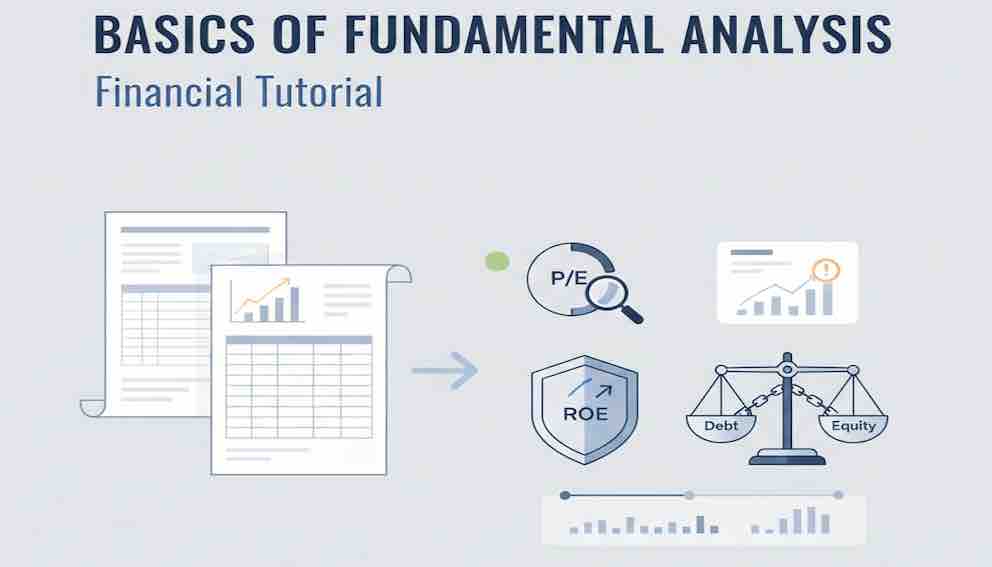
Want to know if a company is a healthy investment or a risky bet? Fundamental analysis is your answer. This guide teaches you to speak the language of business by reading financial statements and using key ratios like P/E and ROE. We'll walk you through a simple company example, show you how to spot red flags and opportunities, and give you a 5-step checklist to evaluate any stock with confidence. Move beyond guesswork and learn how to invest with insight.
Introduction: From Stock Buyer to Business Analyst
Up to now, you've learned to build a sturdy, diversified portfolio using funds. That's the smartest foundation. But what if you want to understand why you own a piece of a company? What if you want to evaluate a stock yourself?
Fundamental analysis is the process of learning the language of business. Instead of just watching a stock's price jump around, you learn to read its financial statements—the official story of its health, profitability, and future potential. This tutorial won't make you a CPA, but it will give you the essential phrases to understand if a company is thriving, surviving, or hiding problems.
Let's learn this language by following a single, familiar example: "BrewHouse Coffee," a growing chain of coffee shops.
Part 1: The Three Financial Statements – The Company's Storybook
Every public company tells its story through three key documents.
1. The Income Statement: The "Report Card"
This answers: "Is the company making money?" It shows performance over a period (e.g., a year).
- Revenue (Top Line): Total sales. BrewHouse sold £10 million worth of coffee and pastries.
- Expenses: Cost of beans, barista salaries, rent, marketing.
- Net Income (Bottom Line / Profit): What's left after all expenses. BrewHouse's profit was £1 million.
Your Takeaway: Look for consistent growth in revenue and profit over 3-5 years. A growing bottom line is a good sign.
2. The Balance Sheet: The "Snapshot"
This answers: "What does the company own and owe right now?" It's a picture at a specific date.
- Assets: What it owns (Cash, Coffee Machines, Property).
- Liabilities: What it owes (Bank Loans, Unpaid Supplier Bills).
- Shareholders' Equity: Assets - Liabilities. The company's net worth.
The Fundamental Equation: Assets = Liabilities + Equity
Example: BrewHouse has £5m in assets (cash, shops) and £2m in loans. Therefore, Equity is £3m.
Your Takeaway: A strong balance sheet has manageable debt (liabilities) compared to what it owns. Too much debt is risky.
3. The Cash Flow Statement: The "Truth Teller"
This answers: "Is the company actually generating cash?" This is crucial because profit on paper (Net Income) is not the same as cash in the bank. A company can be profitable but run out of cash if customers are slow to pay or it spends too much on new equipment.
It breaks cash into three activities:
- Operating: Cash from selling coffee. (This should be positive and growing). This is the lifeblood of the business.
- Investing: Cash spent on new espresso machines or shops (usually an outflow).
- Financing: Cash from taking a new loan or paying out to shareholders.
Your Takeaway: Consistently positive operating cash flow is king. It means the core business is generating real money to fund itself, pay debts, and grow.
Part 2: Key Ratios – The Quick Translation Guide
Numbers in isolation are confusing. Ratios translate them into insights. Here are the most important for beginners. Always look at these ratios over a 3-5 year trend, not just a single snapshot.
1. Price-to-Earnings (P/E) Ratio: The "Popularity Contest"
- Formula: Stock Price ÷ Earnings Per Share (EPS)
- What it asks: "How much am I paying for £1 of this company's profit?"
- BrewHouse Example: Share price = £20. EPS = £2. P/E = 10. This means investors pay £10 for every £1 of BrewHouse's profit.
- How to use it: Compare within an industry. If other coffee chains have P/E ratios of 15, BrewHouse at 10 might be cheaper. A very high P/E means high growth expectations; a very low one could signal trouble or a bargain.
- Important Caveat: The P/E can be distorted by one-time gains or losses. Always check if the earnings (the "E") are from normal operations.
2. Return on Equity (ROE): The "Efficiency Score"
- Formula: Net Income ÷ Shareholders' Equity
- What it asks: "How well is the company using my invested money to generate profits?"
- BrewHouse Example: Profit = £1m. Equity = £3m. ROE = ~33%. That's excellent—for every £1 of equity, it generated 33p in profit.
- How to use it: Look for consistently high ROE (e.g., >15%) over several years. It's a sign of a durable competitive advantage and good management. A sudden spike could be from a one-off event, not sustainable performance.
3. Debt-to-Equity Ratio: The "Risk Gauge"
- Formula: Total Liabilities ÷ Shareholders' Equity
- What it asks: "How reliant is this company on debt vs. its own money?"
- BrewHouse Example: Liabilities = £2m. Equity = £3m. Debt/Equity = 0.67.
- How to use it: Lower is generally safer. A ratio of 2 means it has twice as much debt as equity—risky if sales dip. Compare to industry peers (utilities have high ratios; tech firms have low ones). Watch the trend—is debt growing faster than equity?
4. Profit Margin: The "Efficiency Check"
- Formula: Net Income ÷ Revenue
- What it asks: "Of every £1 in sales, how much turns into profit?"
- BrewHouse Example: Profit = £1m. Revenue = £10m. Profit Margin = 10%.
- How to use it: Compare margins with competitors. A company with a 15% margin is more efficient than one with 5%. Rising margins over time are a great sign.
5. Current Ratio: The "Short-Term Health" Check
- Formula: Current Assets ÷ Current Liabilities
- What it asks: "Can the company pay its bills due within the next year?"
- How to use it: A ratio above 1.0 means it has enough short-term assets (cash, inventory) to cover short-term debts. Below 1.0 could signal liquidity trouble.
Part 3: Putting It All Together – A 5-Step Health Check
Don't get lost in the numbers. Use this simple checklist to evaluate any company.
Step 1: The Trend Test (Look at 3-5 Years of Data)
- Are Revenue and Net Income growing steadily?
- Is Operating Cash Flow positive, strong, and increasing?
- Red Flag: Erratic or declining trends.
Step 2: The Profitability & Efficiency Check
- Is the ROE consistently strong and stable?
- Is the Profit Margin healthy and improving?
- Red Flag: Low, falling, or wildly volatile profitability.
Step 3: The Financial Health & Risk Check
- Is the Debt-to-Equity ratio stable or improving? Is it in line with industry peers?
- Does it have a Current Ratio above 1.0 to handle short-term bills?
- Red Flag: Skyrocketing debt or poor liquidity.
Step 4: The Valuation Sense-Check
- How does the P/E Ratio compare to its main competitors and its own historical average? Is the "E" based on sustainable earnings?
- Opportunity: A quality, financially healthy company with a P/E lower than its peers and history.
Step 5: The "Story vs. Numbers" Check
- Do the numbers match the narrative? Read the "Management Discussion & Analysis" (MD&A) section of the annual report. If management talks about explosive growth but revenue is flat, be skeptical. Look for explanations of one-time events that skewed the ratios.
Applied to BrewHouse (3-Year Trend):
- ✅ Trends: Revenue up 12% per year; Profit up 15%; Cash Flow strong.
- ✅ Profitability: ROE steady at 30-33%; Profit Margin stable at 10%.
- ✅ Health: Debt/Equity steady at 0.65; Current Ratio = 1.5.
- ⚠️ Valuation: P/E of 10 vs. peer avg of 15 – could be undervalued or the market sees a risk.
- ✅ Story: MD&A explains the lower P/E due to planned major expansion (higher short-term costs), aligning with the strong cash flow used for investment.
Verdict: BrewHouse passes the health check. The numbers are strong and consistent. The lower P/E is explained by a clear growth strategy, not hidden weakness, making it an interesting candidate for further research.
Conclusion: You Now Speak the Basics
You don't need to be an expert. You now know enough to look under the hood of a company and ask intelligent questions.
- You can read the story: The Income Statement (profitability), Balance Sheet (health), and Cash Flow Statement (cash reality).
- You can speak in ratios: P/E (valuation), ROE & Margins (efficiency), Debt/Equity & Current Ratio (risk).
- You have a checklist: The 5-Step Health Check gives you a structured way to investigate trends, not just snapshots.
Use this power wisely. For the core of your portfolio, low-cost index funds are still the best choice. But for the portion where you want to pick a stock, this framework turns you from a speculator into an informed investor. You're no longer just betting on a ticker symbol; you're evaluating a business based on its financial story.
About Swati Sharma
Lead Editor at MyEyze, Economist & Finance Research WriterSwati Sharma is an economist with a Bachelor’s degree in Economics (Honours), CIPD Level 5 certification, and an MBA, and over 18 years of experience across management consulting, investment, and technology organizations. She specializes in research-driven financial education, focusing on economics, markets, and investor behavior, with a passion for making complex financial concepts clear, accurate, and accessible to a broad audience.
Disclaimer
This article is for educational purposes only and should not be interpreted as financial advice. Readers should consult a qualified financial professional before making investment decisions. Assistance from AI-powered generative tools was taken to format and improve language flow. While we strive for accuracy, this content may contain errors or omissions and should be independently verified.