
Tutorial Categories
Last Updated: February 9, 2026 at 20:30
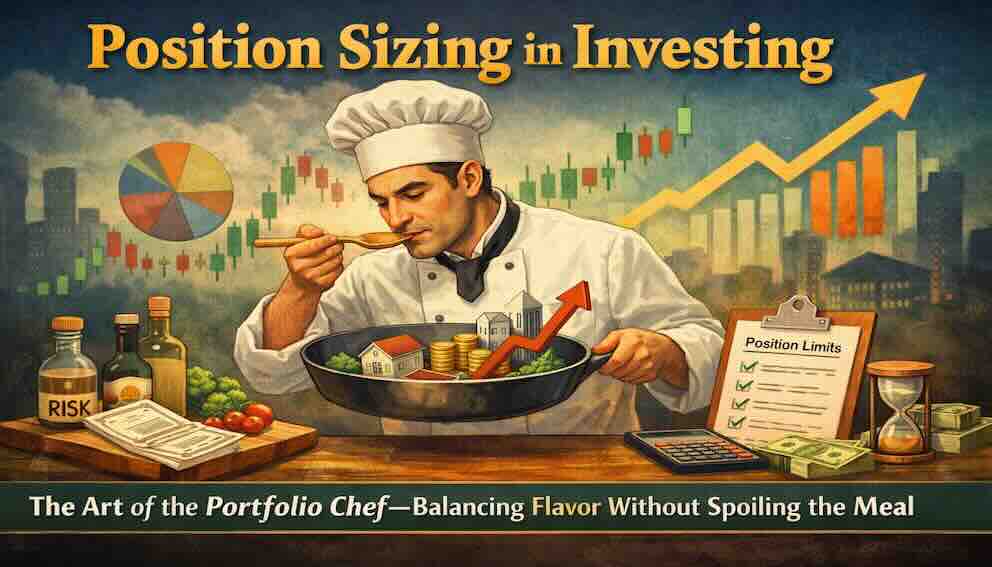
Position Sizing in Investing: The Art of the Portfolio Chef
Position sizing is the quiet discipline that determines whether a good investment idea builds long-term wealth or causes a short-term disaster. This tutorial explores why how much you invest often matters more than what you invest in, how to avoid the catastrophic "bet the farm" mistake, and how simple, personalized rules can protect you from ruin. You will learn to see position sizing not as a restriction on returns, but as the essential framework that allows conviction and compounding to flourish safely. Through practical examples and plain-language reasoning, this lesson shows how to balance confidence with humility in a way that keeps you steadily in the game for decades.
Introduction: The Unseen Architect of Financial Outcomes
When most people think about investing, they imagine a search for brilliant ideas—the next transformative company, the undervalued asset, the emerging trend. This focus on selection is natural, but it obscures a deeper, more powerful force that ultimately dictates success or failure. Two investors can buy the same stock, at the same time, and sell it at the same price, yet their financial lives can tell utterly different stories. One grows steadily wealthier; the other is sidelined by a devastating blow.
The difference is not the idea. The difference is the portion.
Position sizing—the decision of how much of your total capital to allocate to a single investment—is the unseen architect of all investment outcomes. It is the bridge between belief and survival, the translator of confidence into actionable, safe numbers. While picking investments asks, "Is this a good idea?", position sizing asks the more vital follow-up: "How much of my future should I risk to find out?"
This tutorial will show you how to decide, in advance and with calm logic, what "too big" actually means for you. We will explore why oversized bets cripple otherwise intelligent investors, how to balance conviction with essential humility, and how practical sizing rules act as a financial keel, keeping you upright through every storm.
The Central Paradox: Why Size Trumps Selection
It seems counterintuitive: surely the quality of the idea is paramount? Of course, consistently terrible selections will fail. But history reveals a subtler truth: even the most skilled investors are wrong remarkably often. What separates the enduring from the extinct is not infallibility, but survivability.
Imagine two chefs, Alex and Jordan, preparing a ten-course meal for a prestigious dinner.
- Alex decides to feature ten distinct dishes, each carefully prepared with quality ingredients. A few dishes are merely good, one or two might disappoint, but a couple are spectacular.
- Jordan becomes enamored with a single, exotic ingredient. Convinced it will be the talk of the evening, Jordan uses it as the dominant component in every single dish.
The risk is obvious. If the guests adore that one ingredient, Jordan's meal is legendary. But if it clashes with their palates or is somehow flawed, the entire evening is ruined. Alex's meal, by design, cannot be ruined by a single element.
Investing operates on the same principle. You will have mediocre picks, outright failures, and a few strong winners. Position sizing is how you ensure that no single ingredient—no matter how promising—can spoil your entire financial feast.
The mathematics are unforgiving: a 50% loss requires a 100% gain just to break even. Position sizing is the primary tool that prevents you from digging these inescapable holes. In the long run, ideas create the possibility of growth, but position sizing determines whether you live long enough to experience it.
Why We Resist: The Psychology of the Oversized Bet
Oversized positions are rarely born from cold calculation. They are conceived in the heat of emotion—a compelling narrative, a charismatic founder, the fear of missing out (FOMO) as friends profit. Excitement subtly morphs into certainty.
Certainty whispers, "This is different." It argues, "I've done my homework; this is a sure thing." It dismisses the fundamental, permanent truth of the market: Uncertainty.
When you place an outsized bet, you are making an implicit, arrogant claim: "My foresight is near-perfect. I can see the unseeable path ahead." This mindset shuts down humility and replaces probabilistic thinking with a single, compelling story.
The danger is twofold. First, you increase financial risk exponentially. Second, and perhaps more insidiously, you increase behavioral risk. A position that is too large hijacks your emotions. Every price dip feels like a personal indictment, making you prone to panic-selling at the worst moment. The pressure to be right becomes unbearable, clouding the clear thinking essential for good decisions.
People resist disciplined sizing for three main reasons:
- It feels boring. It lacks the drama of an "all-in" story.
- It feels like limiting upside. We overestimate our ability to pick single winners.
- It feels like a lack of confidence. We confuse recklessness with courage.
These instincts are natural but flawed. True confidence is not betting everything on one roll of the dice; it is having a robust process that endures through all rolls.
Position Sizing: The First Line of Defense
Before you find the next great stock, before you diversify, you must have a sizing framework. It is your first line of defense.
Why? Because even perfect analysis cannot compensate for reckless sizing. You can be 100% correct about a company's brilliant future and still go bankrupt if the stock price takes a 70% detour on its way there and your position was too large for you to hold on. Position sizing, paired with rigorous valuation, is what makes your brilliant ideas survivable.
Think of it as the foundation of a house. A beautiful design (your stock pick) is meaningless if the foundation (your sizing) is too weak to support it through a storm.
The "Portfolio Chef" Framework: Risk as Your Kitchen Budget
One of the most practical ways to internalize position sizing is to think in terms of a risk budget. Your total capital is your budget. Each investment is an expense.
A wise chef does not spend 80% of the budget on one ingredient, no matter how exquisite. Why? Because if it spoils, the entire meal collapses. Instead, the budget is allocated across a balanced assortment, ensuring no single failure is catastrophic.
This mindset shifts the key question from "How much can I make?" to "How much am I willing to lose?"
A Step-by-Step Walkthrough: From Budget to Portion
Let's make this concrete with a $100,000 portfolio.
- Define Your Risk Per Idea: You decide that for any single investment, you are comfortable risking no more than 1% of your total portfolio in a worst-case scenario. That's $1,000.
- Estimate the Downside: You analyze a promising tech stock. You love the company, but you acknowledge that during a market panic, high-growth stocks like this can easily fall 40%. Estimating downside is part art, part science—it's about judging volatility and potential permanent loss.
- Calculate the Position Size: This is the key step. To ensure a 40% decline doesn't cost you more than $1,000, you work backward.
- If 40% of Position = $1,000 risk...
- Then 100% of Position = $1,000 / 0.40 = $2,500.
Result: Your maximum position size for this stock is $2,500, or 2.5% of your portfolio. This isn't a guess; it's the logical output of your predefined risk tolerance and your realistic market assumption.
Why Position Size Must Assume Pain, Not Perfection
Risk budgeting often focuses on catastrophic loss (going to zero). But an equally important reason to size positions properly is to survive normal, brutal volatility.
Great companies are not smooth upward lines. Even the most successful stocks routinely experience gut-wrenching drawdowns of 30%, 40%, or even 50% on their long-term journey up. This isn't a sign of a bad business; it's just the market's noisy, emotional nature.
Therefore, your position sizing must answer a crucial question: "Can I sleep peacefully and hold my position through a 40% decline?"
If the answer is "no," then your position is too large—*even if you are 100% correct about the company's long-term prospects*. You will be emotionally forced to sell at the bottom, turning a paper loss into a permanent one. Proper sizing creates the emotional and financial space necessary to be a long-term investor.
The Hidden Trap: Correlation Risk
Risk isn't just about single stocks. It's about the combined behavior of your entire portfolio. You can follow a 5% position limit perfectly yet still have a disastrous 30% bet on a single theme without realizing it.
This is correlation risk. Five different 3% positions in cloud software, semiconductor, and social media companies are not five separate bets. In a market downturn, they will likely all fall together. You haven't diversified; you've created a hidden 15% "tech sector" position.
True diversification isn't just about the number of holdings; it's about the number of unrelated outcomes. A portfolio with stakes in a bank, a healthcare company, a utility, and a tech firm is more resilient than one with ten different tech stocks, because these businesses face different economic forces. You must ensure your portfolio isn't over-reliant on one type of risk.
The "Bet the Farm" Mistake
The phrase “bet the farm” comes from gambling and agriculture and is the ultimate warning in investing. It means staking so much of your capital on a single idea that its failure would inflict permanent, catastrophic damage on your financial life—the equivalent of losing your livelihood. It’s the mistake that ends investing journeys.
In practice, this takes several forms:
- Putting 50%, 80%, or 100% of your portfolio into one stock.
- Concentrating almost entirely in one sector (e.g., "all in on tech").
- Using excessive leverage (borrowed money) to magnify a single bet.
These moves are rarely born from calculation. They are born from a story so compelling it shuts down all humility, convincing you that this time is different and the usual rules of risk don't apply. The mathematics, however, are merciless: a portfolio that loses 50% needs a 100% gain just to break even. A "bet the farm" failure often creates a loss so deep that recovery within a reasonable time frame is mathematically near-impossible.
The rules that follow exist for one primary purpose: to make it structurally impossible for you to ever accidentally "bet the farm."
From Theory to Practice: Simple, Actionable Rules
There is no universal formula, but time-tested rules provide an excellent starting point.
1. The Maximum Position Cap
Set a hard ceiling for any single holding—often between 5% and 10% of the portfolio. This rule enforces a simple truth: No single investment should ever have the power to ruin you.
2. Conviction-Based Sizing Tiers
Use your level of confidence to guide sizing within your cap:
- Low Conviction (Exploratory): 1-2%
- Medium Conviction (Standard): 2-4%
- High Conviction (Maximum): 4-8%
This honors your analytical work while respecting fallibility. There is no iron law. Legendary investors like Buffett and Munger have occasionally taken positions of 20-40% when their conviction was extreme and the margin of safety was enormous. For them, it was a calculated exception, not a habit.
3. The Sleep Test
The simplest rule is often the best: If a position keeps you awake at night, it is too large. Your emotional discomfort is a direct signal that the risk exceeds your personal tolerance.
Grounding in Reality: When Sizing Goes Right and Wrong
History provides sobering lessons on both sides of the sizing equation.
- The Disasters: Bill Ackman's Pershing Square held over 30% of its fund in Valeant Pharmaceuticals. When Valeant's business model unraveled, it caused a massive, reputation-damaging drawdown. Similarly, many retail investors in 2021 concentrated heavily in meme stocks, turning paper gains into devastating real losses.
- The Masters: Warren Buffett built his early partnership returns with concentrated bets, famously putting up to 40% of his fund in American Express after the "Salad Oil Scandal" when he saw a temporary mispricing of a durable brand. Seth Klarman notes, "We size things based on how much we think we can make versus how much we think we can lose."
The difference? The masters combined extreme sizing with extreme selectivity, deep understanding, and a clearly defined margin of safety. For everyone else, the caps and tiers are wiser guides.
The Nuances: Taxes, Liquidity, and Breaking Your Own Rules
A few practical considerations complete the picture:
- Taxes and Trimming: When a winner grows to 15% of your portfolio, trimming it back to 10% triggers capital gains taxes. In a taxable account, this cost can lead some investors to let winners run longer than their rules might dictate—a reasonable, if calculated, deviation.
- Liquidity Matters: A 5% position in a tiny, illiquid stock is far riskier than a 10% position in a mega-cap company. If you need to exit, you may not be able to without moving the price against yourself.
- When to Break the Rules: There may be rare moments of extreme mispricing, where your understanding is deep and the margin of safety is vast. Temporarily exceeding your normal cap can make sense—if you have pre-defined, written criteria for doing so, and you treat it as a high-alert exception, not a new habit.
Conclusion: The Humble Confidence of the Steward
Position sizing is the quiet discipline that separates investing as a sustainable craft from a series of adrenaline-fueled gambles. It is the practice of balancing the confidence born of research with the humility demanded by an uncertain world.
We have seen that the portion size of your investments is more consequential than the investments themselves. We've learned to budget risk to ensure survival, to watch for hidden concentration, and to use simple, personalized rules as our guide.
Ultimately, intelligent position sizing gives you the rarest gift in finance: staying power. Great investors are not those who never make mistakes, but those whose mistakes are never large enough to end their journey. By mastering the art of the portion, you build the unshakable foundation for a legacy of lasting wealth, one carefully measured, survivable step at a time.
About Swati Sharma
Lead Editor at MyEyze, Economist & Finance Research WriterSwati Sharma is an economist with a Bachelor’s degree in Economics (Honours), CIPD Level 5 certification, and an MBA, and over 18 years of experience across management consulting, investment, and technology organizations. She specializes in research-driven financial education, focusing on economics, markets, and investor behavior, with a passion for making complex financial concepts clear, accurate, and accessible to a broad audience.
Disclaimer
This article is for educational purposes only and should not be interpreted as financial advice. Readers should consult a qualified financial professional before making investment decisions. Assistance from AI-powered generative tools was taken to format and improve language flow. While we strive for accuracy, this content may contain errors or omissions and should be independently verified.