
Tutorial Categories
Last Updated: February 9, 2026 at 20:30
When to Sell a Stock: How to Recognize Fundamental Changes, Avoid Emotional Mistakes, and Protect Long-Term Returns
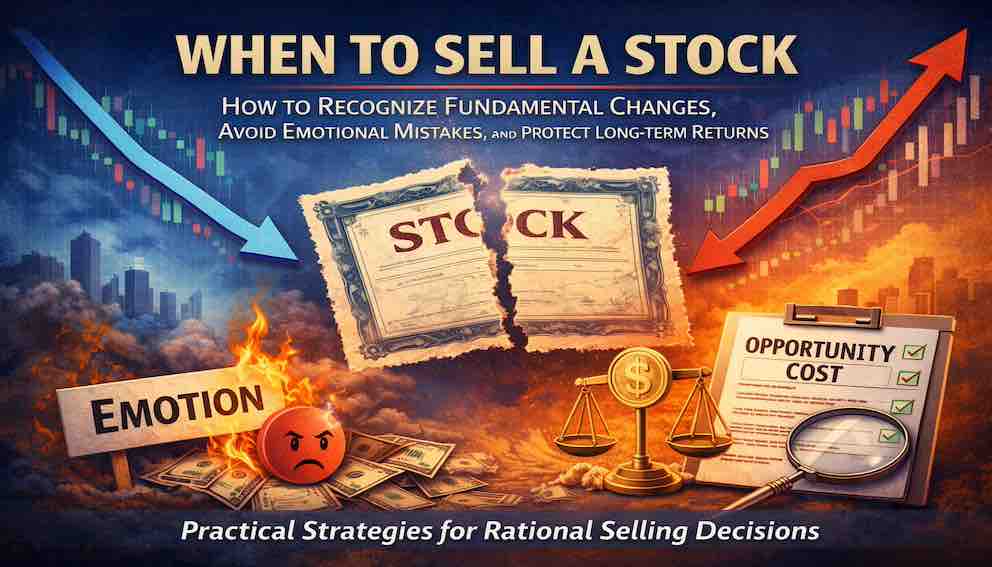
Knowing when to sell a stock is one of the most difficult and misunderstood parts of investing, especially because emotions often feel louder than facts. This tutorial explains how to distinguish between a truly broken investment thesis and ordinary price volatility, so that decisions are driven by business reality rather than fear or excitement. We will explore opportunity cost and why holding the wrong investment can quietly damage your future returns even if you never realize a loss. You will also learn how regret-driven decisions form, why they are so common, and how to design a calm, logical process that protects you from them. By the end, you will have a practical framework for deciding when selling is wise and when patience is the better choice.
Introduction: The Harder Half of the Equation
Buying a stock often feels like an act of optimism and initiation. You research, you envision growth, and you take a step forward. Selling, however, often feels like an act of judgment or surrender. It can feel like an admission that something has gone wrong, either with the company or with your own foresight. This emotional weight is why many investors delay selling far longer than logic dictates, or sell far sooner than patience would reward.
We are taught endlessly how to evaluate and buy, but rarely how to exit with the same clarity. As a result, selling decisions are frequently hijacked by price movements, recent news, or the gnawing fear of regret. A steep price drop feels like danger, even if the company's engine is still humming. A soaring price feels like safety, even if the business is quietly springing leaks.
In this tutorial, we will slow down and examine the decision to sell through a grounded, logical lens. The goal is not to give you a crystal ball, but to provide a decision-making framework—a set of clear questions to ask when the market is loud and your conviction is being tested.
The Foundation: Your Investment Thesis is Your Anchor
Before you can know when to sell, you must know why you bought. An investment thesis is not a vague hope that a stock will go up. It is a specific, articulable set of beliefs about why a company will become more valuable over time.
A strong thesis might sound like: "I own this medical device company because its patented technology gives it a durable advantage in a growing market, its management has a proven track record of smart capital allocation, and its financials show consistent high margins and strong cash flow."
Each part of that statement—the competitive advantage, the management quality, the financial health—is a pillar of your thesis. When you buy, you are betting these pillars will remain strong or grow stronger.
Therefore, a rational sell decision should be triggered not by a falling stock price, but by the deterioration of one or more of these foundational pillars. Your thesis is your anchor; it keeps you from being tossed about by every wave of market sentiment.
Separating Signal from Noise: Thesis Broken vs. Price Volatility
The stock market is a noisy place. Prices react to interest rate fears, analyst downgrades, geopolitical tensions, and social media frenzies. These forces often have little to do with the long-term value of the businesses behind the tickers.
The critical skill is learning to distinguish between price volatility (normal market noise) and thesis breakdown (a fundamental change in the business). This requires evaluating problems as either temporary headwinds or permanent damage.
Consider two identical price charts, each showing a 40% decline:
- Chart A (Thesis Intact): The stock is a leading home improvement retailer. The decline occurs during a broad market panic about rising mortgage rates. However, the company's stores remain busy, its brand is as strong as ever, and it continues to gain market share. The long-term demand for home improvement is unchanged. This is a temporary headwind. The price moved, but the business thesis did not.
- Chart B (Thesis Broken): The stock is a dominant cable television provider. The decline happens gradually over two years. During this time, its subscriber base erodes quarter after quarter as customers permanently shift to streaming services. Management's attempts to adapt are slow and ineffective. The core reason for the investment—a stable, subscription-based customer base—is evaporating. This is permanent damage. Here, the business changed, and the price simply reflected it.
In the first case, selling turns a temporary paper loss into a permanent one. In the second, not selling means tying up your capital in a story that has already ended.
The Three Pillars of a Sell Decision: The Sell Decision Triangle
Now that we understand this distinction, we can build a more complete framework. Think of every potential sale as being evaluated through three lenses: Business Fundamentals, Valuation, and Personal Context. A significant change in any one of these can justify a rational exit.
Pillar 1: The Business Itself (Thesis Strength)
This is the primary lens you've already learned. It asks: is the company's fundamental engine broken?
Signs of a Broken Thesis (Permanent Damage):
- Lost Competitive Advantage: A once-unique product is now commoditized.
- Structural Industry Shift: Think of traditional cameras vs. smartphones.
- Management Deterioration: Erratic capital allocation, ethical lapses, or a consistent pattern of overpromising and underdelivering.
- Financial Erosion: Sustained declines in key metrics like revenue growth, profit margins, or return on capital.
Pillar 2: Valuation (Price vs. Future Prospects)
A wonderful business can become a poor investment. This occurs when the stock price has risen so high that it implies future growth far beyond what is reasonable, making expected future returns unattractive.
Example: You own a fantastic software company. Its prospects are bright, but its stock now trades at 80 times earnings. This price may assume a near-perfect future with no competition or slowdown. If your analysis suggests the realistic annual return from this price is only 2-3% over the next decade, selling or trimming to reallocate to an investment with a 8-10% expected return is a fundamentally sound, opportunity-cost-driven decision. It's choosing a "good investment" over a merely "great company" at a terrible price.
Pillar 3: Personal Context (Your Life & Portfolio)
Your investments serve your life, not the other way around. Selling for personal reasons is not a failure of analysis; it's a fulfillment of purpose.
Valid Personal Triggers Include:
- Life Stage Shifts: Approaching retirement and shifting from growth to capital preservation.
- Risk Tolerance Evolution: Realizing a volatile position causes you undue stress, regardless of its fundamentals.
- Portfolio Rebalancing: A position has grown so large (perhaps a big winner) that it creates dangerous concentration risk. This is where your position sizing discipline directly informs your sell decisions.
- Need for Liquidity: Funding an education, a home, or an emergency.
The Silent Thief: Opportunity Cost
One of the most powerful yet overlooked concepts in selling is opportunity cost. This is the potential return you give up by choosing to keep your capital in one investment instead of moving it to a better one.
Many investors get trapped looking backward at their purchase price. They think, "I can't sell until I'm back to even." This mindset focuses on erasing a past mistake rather than making the best decision for the future.
Imagine you invested $10,000 in Company A, which has stagnated, offering a 2% annual return. Over the same five years, Company B, which you also understood well, compounded at 15% annually. By refusing to sell A and reallocate to B, you haven't just missed gains—you have actively paid an opportunity cost equal to the difference. Your capital was held hostage in a mediocre idea.
A transformative question to ask periodically is this: "If I held cash instead of this stock today, would I buy this company at its current price and situation?"
If the honest answer is "no," then you are holding the stock for emotional, not rational, reasons. You are prioritizing the past over the future.
The Psychology of Regret: Your Worst Advisor
Our selling decisions are often warped by the powerful desire to avoid future regret. We play mental movies:
- "If I sell now and it rockets, I'll feel like an idiot."
- "If I don't sell and it crashes, I'll kick myself for not taking profits."
This fear of emotional pain becomes our primary advisor, clouding our analysis. It leads to two classic mistakes:
- The "Hoping to Get Back to Even" Trap: Holding a losing position long after the thesis has broken, because selling would "lock in" the mistake and make it real.
- The "Bird in the Hand" Mistake: Selling a winning position prematurely during normal volatility, because the fear of losing paper gains outweighs the logic of the intact thesis.
Regret is a backward-looking emotion. Good investing is a forward-looking discipline. You must judge your decisions by the quality of your reasoning at the time you made them, not by the unpredictable short-term outcome.
A Practical Framework: The Sell Decision Checklist
To quiet the noise and neutralize emotion, apply this checklist through the lens of the Sell Decision Triangle. Write your answers down.
1. The Business Check (Thesis):
- Is the company's competitive advantage weaker, the same, or stronger?
- Has management's quality or integrity deteriorated?
- Are the core financial drivers (sales, margins, cash flow) in sustained decline?
- Is this a temporary headwind or permanent damage?
2. The Valuation Check (Price):
- Based on realistic future prospects, what are the expected returns from today's price?
- Is this still one of the best investments I own, or just a great company?
- (The pivotal question) If this were cash, would I buy this stock right now?
3. The Personal & Portfolio Check (Context):
- Has this position grown to create unintended risk concentration?
- Does holding it violate my current risk tolerance or investment policy (e.g., nearing retirement)?
- Do I have a clearly better use for this capital?
If your answers point to a broken thesis, excessive valuation, or a misalignment with your personal context, selling is the rational choice. If all three pillars remain solid, patience is the disciplined path.
The Tool of the Trim & Other Practical Nuances
A final layer of sophistication involves recognizing that selling is not a binary, all-or-nothing decision.
The Power of Trimming: Selling a portion of a position is a precise tool. Trim when a winner creates excessive concentration, when your conviction softens from "high" to "medium," or when you need to raise cash for a new opportunity. Trimming manages risk without the finality of a full exit.
The Reality of Taxes: In taxable accounts, selling triggers capital gains tax. This real cost must be part of your calculation. It often makes trimming more attractive than a full exit and justifies weighing the after-tax opportunity cost of holding versus selling.
Time Horizon is Your Lens: A long-term thesis should be evaluated over years, not months. Short-term price weakness within a healthy long-term story is noise, not a signal. Ensure your selling framework matches your stated investment horizon.
Reinvestment is the Goal: Selling is only step one. Have a thoughtful plan for the capital. Redeploy it into a better opportunity, or hold it as cash ("dry powder") if no compelling ideas exist. The process isn't complete until the capital has a new, intentional purpose.
Conclusion: From Reactor to Steward
We have walked through the difficult terrain of the sell decision. We built a framework around the Sell Decision Triangle—Business, Valuation, Personal Context—to move beyond a narrow focus on price. We confronted the silent drain of opportunity cost and learned to mute the loud, misleading voice of regret.
The ultimate goal is to shift your identity from a reactor, buffeted by price swings and emotional forecasts, to a steward of capital. A steward calmly audits their holdings through a multi-lens framework, reallocates resources from deteriorating or overpriced situations to more fertile ground, and understands that rational selling is a sign of strategic strength, not failure.
By adopting this process, you install a buffer between market chaos and your portfolio. You won't always be right, but you will always be reasoned. And in the long run, it is that consistent, process-driven stewardship—not perfect timing—that builds and preserves enduring wealth.
About Swati Sharma
Lead Editor at MyEyze, Economist & Finance Research WriterSwati Sharma is an economist with a Bachelor’s degree in Economics (Honours), CIPD Level 5 certification, and an MBA, and over 18 years of experience across management consulting, investment, and technology organizations. She specializes in research-driven financial education, focusing on economics, markets, and investor behavior, with a passion for making complex financial concepts clear, accurate, and accessible to a broad audience.
Disclaimer
This article is for educational purposes only and should not be interpreted as financial advice. Readers should consult a qualified financial professional before making investment decisions. Assistance from AI-powered generative tools was taken to format and improve language flow. While we strive for accuracy, this content may contain errors or omissions and should be independently verified.