
Tutorial Categories
Last Updated: February 2, 2026 at 10:30
Fear and Greed: How Emotional Cycles Drive Market Booms and Crashes - Investing Wisdom Series
Markets do not move only because of earnings, interest rates, or economic data; they move because millions of human beings interpret those facts through emotion. This tutorial explores how fear and greed act like a pendulum, swinging markets from pessimistic bottoms to euphoric tops in repeating cycles. You will learn why investors feel safest when risk is highest and most fearful when opportunity is greatest, and how collective emotion shapes prices far more than logic admits. We will also discuss market sentiment indicators at a conceptual level, not as trading tools, but as emotional thermometers. Most importantly, this lesson shows how emotional awareness can be trained like a skill, turning volatility from a threat into a source of long-term calm and clarity.
Introduction: Why Markets Feel Emotional Even When Numbers Look Rational
If you have ever looked at a stock market chart and wondered why prices sometimes rise far beyond what feels reasonable, or fall much more violently than the underlying business news seems to justify, you are already sensing the invisible force that drives markets far more than spreadsheets ever could. Markets are not cold machines that process information in a perfectly logical way, because markets are ultimately made up of people, and people carry emotions into every decision they make, even when they believe they are being objective.
Fear and greed are not flaws that appear only in inexperienced investors or during dramatic crises; they are deeply rooted survival instincts that evolved long before stock exchanges existed, and they quietly influence behaviour even in highly educated, professional, and well-intentioned participants. When prices are rising and everyone around us appears confident and optimistic, greed does not usually announce itself as reckless desire, but instead disguises itself as common sense, social proof, and the comforting feeling that this time the future is obvious. When prices are falling and headlines turn dark, fear rarely feels like panic at first, but instead presents itself as caution, prudence, and the responsible urge to avoid further pain.
In this tutorial, we will slow down and carefully examine how these emotions create repeating market cycles, why fear tends to dominate near market bottoms while greed dominates near market tops, how sentiment indicators attempt to measure these collective feelings, and why developing emotional awareness is not a personality trait but a learnable investing skill that improves with deliberate practice.
The Emotional Market Pendulum: How Feelings Create Cycles
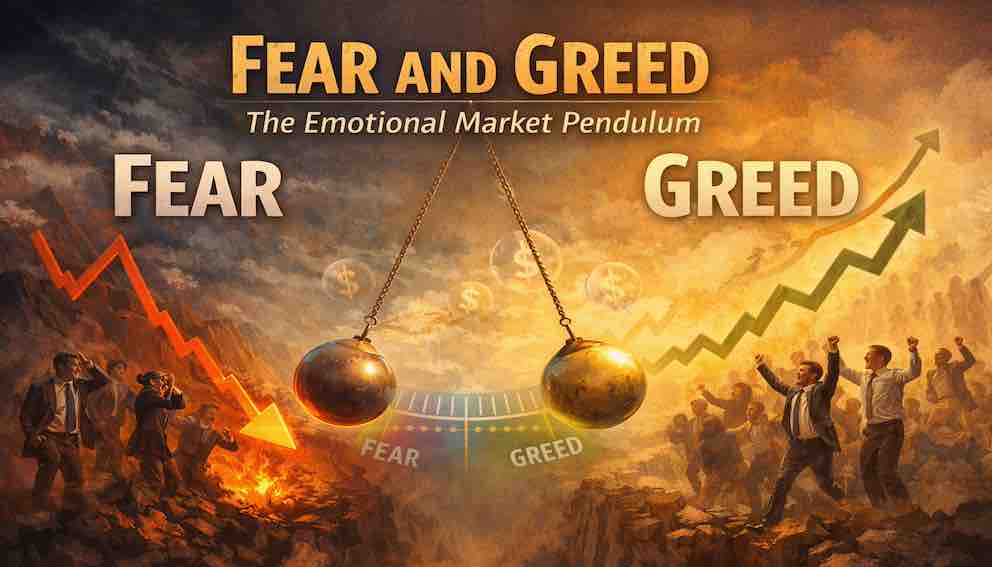
One of the most useful mental models for understanding markets is to imagine them as a pendulum rather than a straight line. A pendulum does not move smoothly from one point to another and stop neatly in the middle; instead, it swings from one extreme to the other, driven by momentum, before gradually reversing direction. Financial markets behave in a remarkably similar way because emotional responses tend to overshoot reality before correcting.
At one extreme of the pendulum lies excessive optimism, where good news is amplified, risks are dismissed, and rising prices reinforce the belief that the future will be better than the present in a smooth and uninterrupted way. At the opposite extreme lies excessive pessimism, where bad news is magnified, uncertainty feels intolerable, and falling prices convince investors that problems will persist indefinitely.
What is important to understand is that these extremes are not created by new information alone, but by how humans emotionally react to information that is often incremental and ambiguous. A modest improvement in economic data during an optimistic phase is interpreted as confirmation that everything is working, while a modest deterioration during a fearful phase is interpreted as evidence that collapse is inevitable. Over time, these emotional interpretations push prices far above or far below what calmer reasoning might suggest, until reality eventually pulls the pendulum back in the other direction.
The Silent Multiplier: How Time Horizon Amplifies Emotion
Here lies a subtle but crucial layer: fear and greed do not affect all investors equally. Their intensity is magnified or diluted by one silent variable—time horizon.
Consider how three different investors might experience the same market decline:
The Day Trader watches prices fluctuate minute by minute. Each small decline triggers immediate anxiety because their entire holding period is measured in hours. Fear isn't just psychological here—it's physiological, a constant cortisol drip.
The Three-Year Investor is saving for a house down payment. A significant decline creates genuine distress because their capital has a specific, approaching purpose. Fear feels practical, tied to real-life plans that may need adjustment.
The Twenty-Year Investor is saving for retirement decades away. They notice the decline intellectually, perhaps with concern, but without the same visceral urgency. Time provides emotional buffer; what feels like an emergency to others feels like volatility to them.
This explains why market panics often feature forced selling from those with the shortest time horizons—they literally cannot afford to wait. Their emotional system is responding to what feels like immediate danger. Meanwhile, those with longer horizons may feel discomfort but can intellectually recognize they're experiencing a chapter, not the conclusion.
This time compression effect reveals something profound: Most investment underperformance comes not from poor analysis, but from reacting to short-term emotions with long-term capital. We allow the nervous system of the day trader to make decisions for our retirement fund.
Greed at the Top: When Confidence Becomes the Greatest Risk
Let's examine a specific historical moment: December 1999. The NASDAQ had risen 85% that year. The dominant narrative was airtight: the internet had changed everything. Traditional metrics like "price-to-earnings" were dismissed in favor of "price-to-eyeballs."
At such extremes, greed operates with remarkable subtlety:
- It disguises itself as inevitability: "You're not gambling; you're investing in the future."
- It's reinforced by social proof: When everyone from your neighbor to the nightly news discusses tech stocks, abstaining feels like stubborn ignorance.
- It invalidates caution: Skeptics are labeled "dinosaurs." Risk isn't analyzed; it's dismissed as outdated thinking.
The neurochemical reality deepens this: consistent gains trigger dopamine releases, reinforcing the behavior that produced them. The brain begins to associate buying with reward, creating a powerful conditioning loop. The investor isn't calculating; they're being conditioned. The greatest danger here isn't the price level, but the conviction that this time, the old rules don't apply.
Fear at the Bottom: When Prudence Becomes the Greatest Cost
Now contrast that with a different moment: March 23, 2020. The COVID-19 pandemic had triggered global economic paralysis. The VIX "fear index" reached its highest level ever recorded.
At this trough, fear operates with equal subtlety:
- It disguises itself as realism: "Selling isn't panic; it's accepting the new reality."
- It's reinforced by catastrophic imagery: Constant news footage makes worst-case scenarios feel like the base case.
- It invalidates hope: Talk of recovery seems reckless. The brain floods with cortisol, narrowing focus to immediate threats and obscuring long-term perspective.
Here we encounter a crucial distinction: Markets move in prices, but humans live in experiences. A -30% chart is abstract data. A -30% portfolio combined with alarming headlines, concerned family members, and uncertainty about employment is a lived psychological event. This explains why even educated investors with sound plans can struggle during crises—they're not responding to percentages, but to the complete emotional experience those percentages represent.
Reading the Emotional Weather: Sentiment as Context, Not Crystal Ball
How can we gauge where the pendulum sits in its swing? This is the realm of market sentiment indicators—tools that attempt to measure collective emotion. It's vital to approach these conceptually rather than mechanically.
Common sentiment measures include:
- The CNN Fear & Greed Index (composite of market momentum, volatility, and safe-haven demand)
- Put/Call Ratios (measuring bearish versus bullish option trading)
- Investor Surveys (like the AAII Bull/Bear spread)
Here, a crucial guardrail is necessary: Sentiment extremes are background conditions, not timing triggers. They tell you about the emotional environment, not when it will change. "Extreme fear" can persist for weeks; "extreme greed" can intensify further. The utility lies not in precision, but in perspective. When indicators scream "greed," they suggest emotional fuel for further rallies may be depleted. When they scream "fear," they suggest emotional selling pressure may be exhausted.
These tools answer a valuable question: "Am I swimming with an emotional tide, or against it?" But they provide context, not permission. They help you understand the weather; they don't tell you when the storm will pass.
Training the Inner Observer: A Practical Framework
Emotional awareness isn't a trait you're born with; it's a skill you develop through practice. Here is a three-part framework to build this capacity:
1. The 48-Hour Feeling Journal
When you feel a strong urge to make a portfolio change—whether to chase a "hot" opportunity or escape a "broken" holding—your first action shouldn't be to trade. Open a notes app and complete this sentence:
"I'm feeling a strong urge to [ACTION] because I feel [EMOTION]. The story I'm telling myself is [NARRATIVE]. The concrete evidence for this, excluding recent price movement, is [EVIDENCE]."
Set a 48-hour timer. Re-read your entry when it goes off. You'll find most urgent feelings have either clarified or dissolved. This practice builds the essential gap between impulse and action.
2. Time Horizon Alignment Ritual
Before checking your portfolio during volatile periods, consciously state your primary investing time horizon aloud: "This is for retirement in 2040" or "This is for my child's education in 10 years." This simple verbalization reconnects you to your actual timeframe, counteracting the market's constant present-tense urgency.
3. Emotional Rebalancing
Instead of rebalancing on a rigid calendar, use emotional extremes as contextual triggers. When euphoria dominates and your portfolio drifts heavily toward risk, that's your cue to mechanically rebalance back to your plan. When fear prevails and you're overweight cash, that's your cue to mechanically deploy according to your predetermined schedule. You're using the market's emotion to fuel your discipline.
Conclusion: The Emotional Ecologist's Perspective
Understanding fear and greed isn’t about eliminating emotion—that’s impossible. It’s about changing your relationship with it: from reacting to observing, from being swept along to becoming an emotional ecologist.
Like an ecologist studying a forest, you learn that fire isn’t simply “bad.” It is a natural, cyclical force that clears deadwood and makes way for new growth. You don’t stand in the blaze, but you don’t deny its role either. Similarly, greed and fear are natural forces in markets. They clear excess and create opportunities. Your job isn’t to predict exactly when they appear or disappear, but to understand their patterns, respect their power, and structure your investing life so you can survive their swings and take advantage of their lessons.
This perspective turns volatility from a threat into a teacher. When mania rises, you’ll feel greed but recognize it as a temporary wind. When panic strikes, you’ll feel fear but see it as a passing storm. Your strength won’t come from feeling nothing, but from understanding your emotions, why they are intense, and having systems and principles in place that guide action despite them.
That is the quiet power of the market pendulum: it allows you to stand still while the world swings—not with indifference, but with calm awareness that emotions move markets, and that by understanding their motion, you don’t need to be swept along.
About Swati Sharma
Lead Editor at MyEyze, Economist & Finance Research WriterSwati Sharma is an economist with a Bachelor’s degree in Economics (Honours), CIPD Level 5 certification, and an MBA, and over 18 years of experience across management consulting, investment, and technology organizations. She specializes in research-driven financial education, focusing on economics, markets, and investor behavior, with a passion for making complex financial concepts clear, accurate, and accessible to a broad audience.
Disclaimer
This article is for educational purposes only and should not be interpreted as financial advice. Readers should consult a qualified financial professional before making investment decisions. Assistance from AI-powered generative tools was taken to format and improve language flow. While we strive for accuracy, this content may contain errors or omissions and should be independently verified.