
Tutorial Categories
Last Updated: February 2, 2026 at 10:30
Loss Aversion Explained: Why Investors Fear Losses More Than They Value Gains - Investing Wisdom Series
Why does losing $1,000 feel far worse than the happiness of gaining $1,000? This tutorial explores loss aversion, a core idea from behavioral economics developed by Daniel Kahneman and Amos Tversky, which explains why humans are wired to fear losses more than they value gains. Using real market examples—from stock market crashes to everyday investing mistakes—we’ll see how loss aversion quietly distorts decisions, delays action, and increases long-term regret. By understanding this bias clearly and calmly, investors can begin to recognize when emotions are steering the wheel instead of logic. The goal is not to eliminate fear, but to learn how to coexist with it wisely.
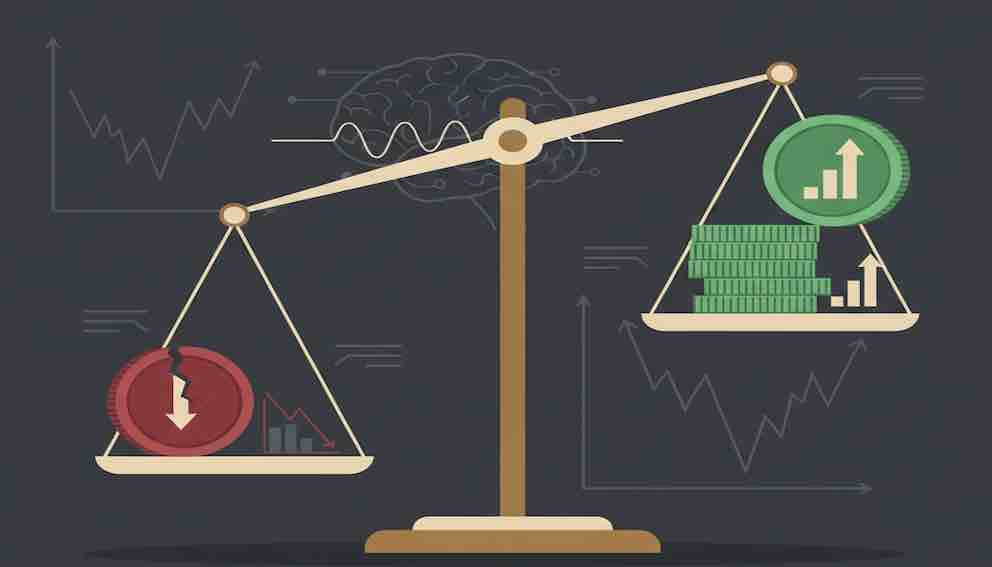
The Unequal Scale of Human Emotion
In October 2008, as global markets were collapsing, something remarkable happened in the psychology laboratories of University College London. Researchers monitored brain activity while subjects made financial decisions. They discovered something profound: when people anticipated financial losses, their brains lit up in the same regions that process physical pain and primal fear. Gains, by contrast, activated reward centers with far less intensity.
This wasn't just academic curiosity. This neurological reality explains why, during that same October, ordinary investors were doing something seemingly irrational: selling stocks at 40-50% losses, converting temporary paper declines into permanent financial destruction. They were experiencing something far more powerful than logic—they were feeling the evolutionary equivalent of a physical threat.
This is loss aversion: the psychological principle that losses loom larger than equivalent gains. The pioneering work of psychologists Daniel Kahneman and Amos Tversky suggests the ratio is approximately 2:1—losing $1,000 feels as bad as gaining $2,000 feels good. But in moments of market panic, this ratio can become even more distorted.
The Nobel-Winning Discovery That Changed Everything
Before Kahneman and Tversky's work in the 1970s, economic theory operated on a comforting but flawed assumption: that humans are rational actors who carefully weigh probabilities and outcomes. Their research revealed a more complex, more human reality.
Consider one of their simplest yet most revealing experiments:
Scenario A: You're offered two choices:
- A guaranteed gain of $500
- A 50% chance to gain $1,000 and 50% chance to gain nothing
Most people choose option 1—the sure gain. This seems reasonable.
Scenario B: Now you're offered:
- A guaranteed loss of $500
- A 50% chance to lose $1,000 and 50% chance to lose nothing
Suddenly, most people choose option 2—the risky gamble. The mathematics are identical to the first scenario, but the psychology has flipped completely.
Kahneman would later explain this in his Nobel Prize lecture: "The response to losses is more extreme than the response to gains. We found that people needed about twice as much gain to compensate for a loss of a given size."
This discovery gave birth to Prospect Theory, which would earn Kahneman the Nobel Prize in Economics in 2002 (Tversky had passed away, otherwise he would have shared it). For the first time, psychology had provided a mathematical framework for understanding why investors behave in ways that seem economically irrational.
The Evolutionary Roots: Why We're Wired This Way
To understand why loss aversion feels so instinctive, we must travel back approximately 200,000 years to the African savannah. Our ancestors faced a simple but brutal reality: losing your food stores meant starvation. Losing your shelter meant exposure. Losing your place in the tribe meant death. Gains—an extra day's food, slightly better shelter—were helpful, but losses were catastrophic.
Evolution selected for brains that treated potential losses with extraordinary urgency. The individual who felt the pain of loss intensely and acted immediately to prevent it survived. The one who felt losses lightly did not pass on their genes.
Fast forward to today: when we see our portfolio decline by 10%, that same neural alarm system activates. Our brain doesn't distinguish between losing your food to predators and losing value in your retirement account. Both trigger the amygdala—the brain's threat detection center—which prepares us for fight or flight, not thoughtful analysis.
This explains why during the COVID-19 market crash of March 2020, perfectly rational people did irrational things. A retired teacher in Ohio (who asked not to be named in financial counseling records) sold her entire portfolio on March 23rd—the absolute bottom of the crash—locking in 35% losses. "I couldn't sleep," she later confessed. "Every time I closed my eyes, I saw the numbers going down. Selling felt like stopping the bleeding." Her portfolio would have fully recovered by August, but her decision was permanent.
The Four Faces of Loss Aversion in Investing
Loss aversion manifests in predictable patterns that quietly erode wealth over decades:
1. The Disposition Effect: How We Treat Winners and Losers Differently
In 1998, researchers Terrance Odean analyzed 10,000 brokerage accounts and discovered a pattern so consistent it earned a name: the disposition effect. Investors were 50% more likely to sell winning positions than losing ones. Why? Because selling a winner gives you the pleasure of a realized gain. Selling a loser forces you to confront the pain of a realized loss.
Consider the case of two hypothetical investments: Infosys purchased at ₹500 now trading at ₹800, and Yes Bank purchased at ₹200 now trading at ₹50. The rational decision might be to sell Yes Bank and reallocate to stronger opportunities. The loss-averse decision is to sell Infosys ("take the profit") and hold Yes Bank ("it'll come back"). Over years, this pattern guarantees that your portfolio becomes a museum of past mistakes.
2. The Endowment Effect: Why We Overvalue What We Own
Once we own something, we immediately value it more highly. Kahneman demonstrated this by giving half a class coffee mugs and asking how much they'd sell them for. The owners wanted about twice what non-owners were willing to pay. This isn't rational pricing—it's emotional attachment.
In investing, this means we hold onto stocks long after their fundamentals deteriorate. We become attached to our first investment, the company we worked for, the stock our father recommended. We don't see it as a security with a price; we see it as part of our story. The emotional cost of selling feels like betrayal, so we hold through further declines.
3. The Sunk Cost Fallacy: Throwing Good Money After Bad
In 2011, a trader at a major investment bank (the story appears in multiple post-crisis analyses) continued doubling down on losing positions in mortgage securities. "I can't sell now," he told his manager. "We have too much in already." This is the sunk cost fallacy—the irrational decision to continue investing in a losing proposition because you've already invested so much.
Individual investors do this constantly. They average down on failing stocks, pour more money into underperforming funds, or refuse to exit bad investments because "I've held it this long." They're not evaluating the investment's future prospects; they're trying to avoid admitting past mistakes.
4. Mental Accounting: The Fiction That Some Money Matters Less
Richard Thaler, another Nobel laureate in behavioral economics, identified "mental accounting"—we treat money differently based on where it comes from or how we label it. A $10,000 gain from a speculative trade feels like "house money" to gamble with. A $10,000 loss from your conservative retirement fund feels like a devastating theft.
This explains why people take extraordinary risks with trading profits they would never take with their salary savings. The money feels different, even though rupees are fungible. Loss aversion is temporarily suspended because the gain doesn't feel like "real" money—until it becomes a loss, which feels very real indeed.
The Market's Magnification: How Loss Aversion Creates Systemic Effects
Loss aversion doesn't just affect individuals—it shapes entire markets. During the 2008 financial crisis, the fear of recognizing losses created what economist Paul Krugman called a "zombie bank" phenomenon. Financial institutions refused to sell toxic assets at market prices because doing so would mean booking enormous losses. Instead, they held them, hoping for recovery, paralyzing the entire financial system.
Similarly, in the 2000 dot-com crash, individual and institutional investors alike held onto collapsing tech stocks because selling meant admitting the bubble was real. The NASDAQ fell 78% from peak to trough, but most investors rode it all the way down, unable to accept the psychological pain of selling at a loss.
The Practical Consequences: What Loss Aversion Really Costs
Let's quantify this with a real-world comparison. Consider two investors from 2010 to 2020:
Investor A experiences moderate loss aversion. She panics during the 2011 European debt crisis, selling 30% of her equity holdings. She misses the rebound. In 2015-16, she becomes overly conservative after a minor correction, moving to 60% cash. She misses much of the 2017-19 bull market. Her annual return: approximately 6%.
Investor B has similar knowledge but understands his loss aversion tendencies. He writes an investment policy statement in 2010 that prohibits selling during declines of less than 20%. He sets up automatic rebalancing. During downturns, he follows his written plan. His annual return: approximately 10%.
The difference seems modest—just 4% annually. But over that decade, on a starting investment of $10k, Investor A would have approximately $17.9k. Investor B would have $25.9k. That $8k difference represents a significantly higher compounded gain. All created by different responses to the same emotional triggers.
Beyond Awareness: Practical Strategies That Actually Work
Understanding loss aversion is the first step. Building defenses against it requires more than willpower—it requires systems.
Framework 1: Delay Action, Not Evaluation
Instead of committing to a fixed waiting period before selling, wiser investors separate emotional reaction from analytical review.
When a loss triggers discomfort, the rule is not “do nothing,” but rather:
Do not act until I have explicitly reviewed whether the original investment thesis is intact.
This review focuses on fundamentals, not price:
- Has the business model deteriorated?
- Has debt increased beyond sustainability?
- Has management credibility changed?
- Has the competitive landscape shifted permanently?
If the answer is yes, delay becomes denial.
If the answer is no, delay becomes discipline.
Time alone does not restore rationality. Structured evaluation does.
Framework 2: Pre-Commitment to Reasons, Not Percentages
Price-based thresholds feel objective, but they are blunt instruments. A 25% decline caused by market-wide panic is very different from a 25% decline caused by accounting fraud or structural disruption.
A more resilient approach is to pre-commit to decision criteria, not price levels.
For example:
- “I will reconsider this investment if its balance sheet leverage materially worsens.”
- “I will exit if the company loses pricing power in its core market.”
- “I will reduce exposure if management behavior violates stated capital allocation principles.”
These criteria anchor decisions to business reality, not emotional pain thresholds.
Framework 3: Reframing the Ownership Question — Without Turning Discipline Into Overtrading
The question,
“If I didn’t already own this, would I buy it today?”
is one of the most useful tools for exposing emotional attachment. It forces the investor to step outside the comfort of familiarity and view the investment as it truly is: a claim competing for scarce capital.
However, this question must be handled with care.
Markets move constantly. Prices fluctuate daily. If this question is applied mechanically in response to every price movement, it can quietly turn reflection into overtrading. Discipline then becomes activity, and activity is often mistaken for control.
Rebalancing, when done thoughtfully, is not a failure of conviction. It is a recognition that markets drift and portfolios change shape over time. Allowing asset weights to realign periodically is a form of maintenance, not a signal that the original decision was wrong.
The danger arises when investors begin to re-litigate every holding after every market move. This behavior does not improve decision quality; it amplifies noise. It replaces long-term judgment with short-term reaction, even when wrapped in the language of rational review.
A wiser framing adds two clarifying questions:
- Has anything meaningful changed in the business or its long-term prospects?
- Am I responding to new information, or simply to discomfort caused by price movement?
Rebalancing acknowledges uncertainty while preserving structure. Overtrading responds to uncertainty by constantly seeking relief through action. The former supports long-term discipline. The latter slowly erodes it.
The goal is not to freeze portfolios in place, nor to continuously reshape them in response to emotion. It is to allow change when change is warranted, and to allow time to do its work when it is not.
Framework 4: Risk Allocation, Not a ‘Loss Budget’
The idea of a “loss budget” can quietly legitimize speculative behavior under the illusion of control. Markets do not respect psychological compartments.
Instead, seasoned investors think in terms of risk allocation:
- Core capital allocated to resilient, cash-generating assets
- Peripheral capital allocated to higher uncertainty, with clear expectations of volatility
- Explicit recognition that some risks are acceptable, but none are consequence-free
Losses are never “planned,” but risk is intentionally sized. This distinction matters.
Framework 5: Historical Perspective With a Survival Filter
History is a powerful antidote to panic—but only when used carefully.
Markets as a whole have recovered from every major crisis.
Individual companies have not.
Wise historical framing asks two questions simultaneously:
- “Has the market recovered from similar episodes?”
- “Did all participants recover, or only the survivors?”
This dual perspective prevents the most dangerous form of loss aversion: assuming that time alone heals all investments.
The Deeper Lesson: Loss Aversion Becomes Dangerous When It Masks Information
Loss aversion is not most harmful when it causes fear.
It is most harmful when it prevents recognition.
Fear can be managed.
Denial compounds.
The investor’s task is not to eliminate emotional discomfort, but to ensure that discomfort does not silence evidence, delay learning, or override judgment.
The Paradox of Acceptance: Why Fighting Loss Aversion Makes It Stronger
Here lies one of the most important insights: the more you try to eliminate loss aversion, the more power you give it. The goal isn't to become someone who doesn't feel the sting of losses—that's impossible. The goal is to become someone who recognizes the sting as a signal, not a command.
Even Daniel Kahneman, after a lifetime of studying these biases, admits he still feels them. In interviews, he's said, "I'm just as vulnerable to them as anyone. The difference is I can sometimes catch myself." That catching—that moment of recognition—is where the space for better decisions opens up.
Conclusion: Making Peace with Our Ancient Wiring
Loss aversion is not a flaw to be fixed; it is part of being human. This wiring kept our ancestors alive through famine, danger, and uncertainty. It is why we protect what we have, care about our resources, and feel responsible for our financial well-being.
The challenge—and the opportunity—of modern investing is learning to honor this ancient wiring without letting it dictate our financial decisions. We can notice the tightness in our chest when a portfolio declines, yet still follow a carefully constructed plan. We can feel the urge to sell during panic, while choosing instead to rebalance thoughtfully according to our predetermined rules.
Investing wisdom emerges in the tension between instinct and rationality. It is not about becoming perfectly logical. It is about being thoughtfully human. The same person who would have guarded the fire against the dark, protecting what little they had, still lives within us. Their fear is real. Their protective instincts are valuable.
Our task is not to silence these instincts, but to partner with them. We channel their urgency into systems and structures that serve our long-term goals, rather than reacting impulsively to short-term market swings. In doing so, we not only protect our portfolios, but also develop a more compassionate relationship with ourselves as investors. Emotional reactions are no longer failures; they are signals, guiding us to understand our vulnerabilities and build stronger frameworks.
In the end, the most valuable return from understanding loss aversion is not measured in rupees or percentages. It is measured in nights of better sleep, in decisions made with clarity rather than panic, and in the quiet confidence that comes from knowing we cannot control markets—but we can understand, and thoughtfully navigate, our own human nature.
About Swati Sharma
Lead Editor at MyEyze, Economist & Finance Research WriterSwati Sharma is an economist with a Bachelor’s degree in Economics (Honours), CIPD Level 5 certification, and an MBA, and over 18 years of experience across management consulting, investment, and technology organizations. She specializes in research-driven financial education, focusing on economics, markets, and investor behavior, with a passion for making complex financial concepts clear, accurate, and accessible to a broad audience.
Disclaimer
This article is for educational purposes only and should not be interpreted as financial advice. Readers should consult a qualified financial professional before making investment decisions. Assistance from AI-powered generative tools was taken to format and improve language flow. While we strive for accuracy, this content may contain errors or omissions and should be independently verified.